A Google account has become the most powerful tool that any entrepreneur or small business owner could ever hope for. While Google’s general public brand has been tied to Search, Google has been building a monopoly that can and will change the shape of business, politics, and education forever. In fact, Google is Web 3.0!
Google has many, many tools and products in its offering, most of which are free! If you have not taken the time to look around I suggest you spend a few minutes and start to familiarize yourself with them, they will save or make you A LOT OF MONEY!!!
Google recently made a few updates, but the top bar has been around for longer than most realize, it is in this bar that Google is writing the book on Web 3.0.
What is it that makes Google such a force? Why is Google Plus or G+ such a big deal?
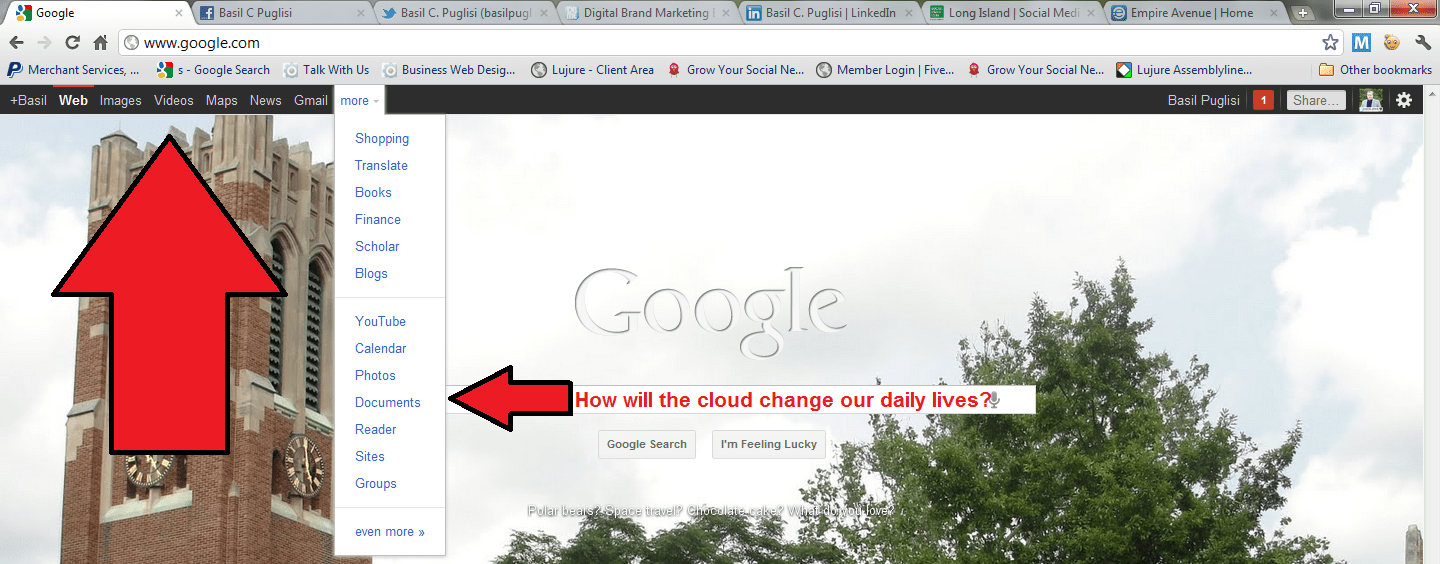
As seen above, Google has captured the “cloud” era ahead of schedule. Without even looking at the advanced features or Google Apps, one can create and store documents on their google account, set appointments organize and share a calendar, find new information and search for products, solutions, books, or even watch a movie or a how to video.
Social Media has changed the way that people interact and use the web, in fact web 2.0 was all about social media. Websites, software and plug-in updates that allowed people to interact with one another and turned a one directional internet into a multi directional web. In web 2.0 not only can you talk back to the media or information source, you could share it or pass it around. The individual web user could claim the brand of a company for better or worse. Dell had individuals that were not related or employed by the company providing customer support in the forums, and Milton’s Scrabble lost thousands, arguably millions in its brand because two other developers claimed the brand in Facebook.
Web 3.0 has been branded the “cloud” era where information, both public and personal is stored on the world wide web and accessed via data plans, Wifi or traditional cable and dial up. This includes massive files for things like high definition media, entire company databases, etc. This is really not something that is new, just look at how startups like Patch Media use google to simulate a traditional IT infostructure or Saleforce.com to organize track and distribute leads, sales and work. With only one main hub in NYC, Patch Media delivers people and content without traditional overhead in over 800 communities around the United States.
Google Plus bridges the gap between Web 2.0 and Web 3.0
In Google Hangout people interact in a real time public space. Others now have to rethink how they look, speak and the body language or facial features that they use. (The innovative marketers and advertisers will need to think how to get a coke can on the desk during that hangout, how to get a new movie poster on the wall behind that person on the hangout etc.)
Google Hangouts has a game changing advantage for those that know how to present, speak and are truly genuine in public. Users should be aware that this new social tool is a lot like “Larry King Live” and you better be prepared for questions that you may not want to answer.
Google Plus has an A symmetrical sharing system, which means that we can send to others but not get a share in return. G+ from its creation allows users to separate professional and personal lives and even organize beyond the largest separation issue that has plagues social users. This interface along with many other features makes Google Plus the most advanced social media site/tool/software that has ever been created, but all that pales in comparison to why Google is so powerful in web 3.0.
If you are in a space where you are using social in a way that allows you to network and share both your personal life and professional life, what could be better than the Google suite of products? You can share and update documents in real time, video conference, make appointments, develop leads, search out information, shop and buy products, services and so on…
A small business now has an IT Dept. in one place. They can seek out support, generate leads, share reports, organize their schedule, promote their business with video, learn from other videos, advertise in Search, not to mention capture the power of social or viral activity. The digital business can now provide face to face support in a familiar environment something that many still crave.
A teacher or tutor can instruct a class or group from half way around the world, share documents, collect home work in real time. A educator or small college can now reach millions and take online learning into a space that captures the best of brick and mortar with distance learning once only done through text based posts.
A politician can capture and organize moral entrepreneurs, organizations and supporters from an account that brands who they are, what they are doing and interact with them with little or no technical experience or knowledge.
The shift in the world economy has come from millions of individuals competing with large corporations and brands that once held a monopoly on professional marketing, networking and talent. Thanks to a Google account you can now work with the best talent, develop a impressive network and generate a brand that is professional, technologically competitive and organized.

Sources:
Leave a Reply