Basil C. Puglisi, MPA, is an AI governance speaker, presenter, and moderator.
He brings one question to stages, working groups, classrooms, and panels: when AI shapes a decision, who decided, on what evidence, and who answers for the result. His sessions draw on Governing AI: When Capability Exceeds Control and the frameworks of the HAIA Ecosystem. Behind them sits a record of producing, hosting, moderating, and teaching at events since 2011. Most recently, he presented the standard of proof for AI accountability in advertising at IAE Summit II in New York.
Teachers NOT Speakers: every session should leave people able to do something they could not do when they walked in.
He teaches, moderates, and joins panels as a volunteer, and every session connects to the work in his books and frameworks. The approach started in 2012 and has not changed since: a speaker tells an audience what the speaker knows, while a teacher owes the audience something it can use once the session ends.
Event organizers can ask about a talk, a working session, or a moderated panel at me(at)basilpuglisi[dot]com.
Recent Presentation: AI Accountability at IAE Summit II
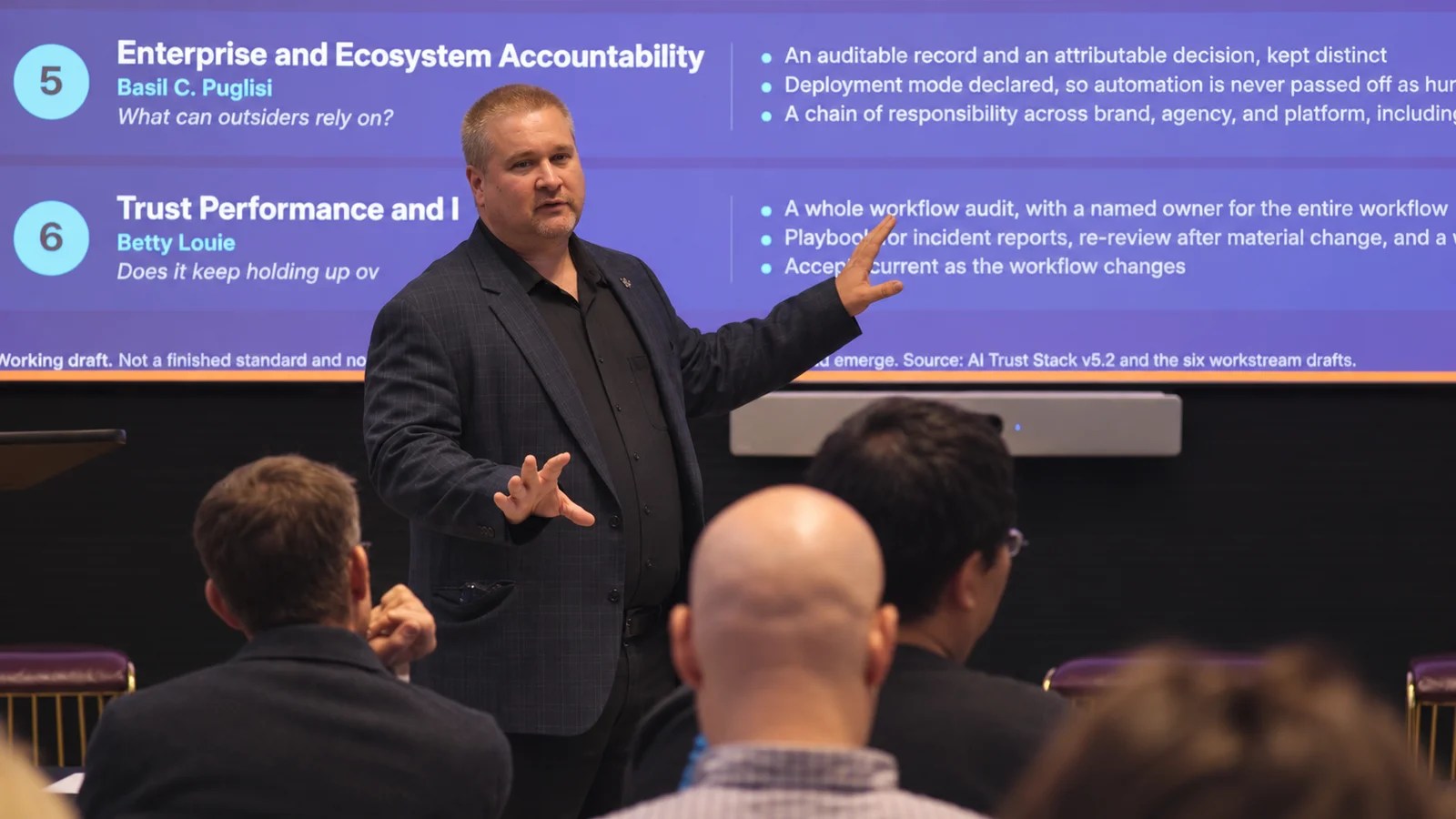
On October 12, 2026, Basil presented Trust Stack Layer 5, Enterprise and Ecosystem Accountability, at IAE Summit II: The Elements of Intention, hosted at Omnicom in New York. He serves as volunteer Chair of the Layer 5 working group at the Institute for Advertising Ethics. The IAE is a registered 501(c)(3) nonprofit educational foundation that works on ethical standards across advertising communications. Its Governance Lab builds practical standards for accountable advertising, with the IEEE Standards Association as its knowledge partner.
Layer 5 asks what outsiders can rely on. The talk set out the working draft, which keeps an auditable record and an attributable decision distinct. It calls for a declared deployment mode, so automation is never passed off as human judgment, and for a chain of responsibility across brand, agency, and platform that reaches shadow AI and the board. Layer 5 owns the standard of proof, because a claim without a record is a marketing statement.

The session also set the five-tier maturity model from The AI Risk Economy beside two proposed audit tiers, one internal and one independent. Both came out of the group’s work with Layer 6 lead Betty Louie, and the group has not yet adopted them. The chair role is volunteer, and the frameworks, papers, and books on this site remain Basil’s independent work.
Read how the Trust Stack layers fit together on the About page
AI Governance Speaking Topics
Topics come from the books, the frameworks, and the working group and policy work now under way, and each one is shaped to the audience in the room.
From Governing AI: When Capability Exceeds Control
- When Capability Exceeds Control: why AI can inform a decision, but a named human has to own it.
- Checkpoint-Based Governance in Practice: the named human at the decision, with a record of who decided, on what evidence, and why. CBG
- Multi-AI Review: running one question across several AI platforms at once so the disagreement between them becomes the evidence. HAIA-CAIPR
- Making AI Show Its Work: the ten-field format that makes any AI platform show its work, and the workflow that spreads the work across platforms by job. HAIA-RECCLIN
- AI Literacy as Governance Competence: measuring the ability of a human to direct, challenge, verify, and own work done with AI. HEQ and AIS
From the Current AI Governance Work
- The Standard of Proof for AI in Advertising: what an outsider can rely on when AI shapes the work, built on auditable records, attributable decisions, and a chain of responsibility across brand, agency, and platform. Trust Stack Layer 5
- The AI Risk Economy: how liability and insurance pressure move organizations from Ethical AI and Responsible AI toward AI Governance with structured audit records. The AI Risk Economy
- What Is an Agent? Code, Human, or Both: where an AI agent should stop, where a named human should decide, and who answers for what the agent does. HAIA Agents
- When AI Becomes Assistive Technology: when general-purpose AI works as a disability accommodation, and how AI policies can become accessibility barriers. AIDA

From the Digital Factics Series
- Factics: every fact must lead to a tactic, and every tactic must leave evidence, from the 2012 method to AI-assisted work today. Factics
- Digital Factics X: building audience, authority, and revenue on X with tactics that leave measurable results.
- Digital Factics Instagram: visual era strategy for small businesses and nonprofits, drawn from the book now in production.
- Being the Human Voice AI Can Find: how people and organizations show up accurately when AI answers the questions search used to answer.
From The Minds That Bend the Machine
- The Thinkers Shaping AI Governance: where the leading voices agree, where they split, and what their disagreements mean for the people who have to make decisions.

Speaking, Presenting, and Moderating Formats
Sessions run 60 to 90 minutes and are offered in person or by video. Each one is built around a single question the audience can act on, with facts, tactics, and a way to measure the result.
- Talks and teaching sessions for conferences, summits, university programs, professional associations, and nonprofits, drawn from a book or framework and shaped to the audience.
- Working group presentations that put a draft standard in front of the people who would have to use it, as at IAE Summit II.
- Panel moderation that keeps disagreement on the table, so the audience hears where experts differ and why, instead of a stage full of agreement.
- Panelist participation on AI governance, human accountability, AI accountability in advertising, AI literacy, and digital strategy.
- Classroom and guest lecture sessions for courses in public administration, criminal justice, communications, and technology.
Basil participates as a volunteer. At this time, he is not available for long days or for commitments of more than two days in a row, and video participation remains open for programs that fit a shorter format.
To ask about a session or panel, write to me(at)basilpuglisi[dot]com with the event, the audience, the date, and whether it runs in person or by video.

How Teachers NOT Speakers Began
The format changed because the early events showed what the standard model left out. Social Media Action Camp ran in 2011 at the Roger Smith Hotel in New York City, and the Social Mobile Analytics Content Event followed in February 2012 at Steel Case during Social Media Week. Both used the same speaker method and slogan format, with speakers on a stage and an audience in chairs.
Those events drew strong numbers, and the February 2012 event became the most socially shared event worldwide for Social Media Week 2012. The format still centered on the speaker, though, and the question of what the audience actually took home rarely got asked.

In October 2012, at the Social Mobile Analytics Content Summit at NYXPO in the Javits Center, Basil introduced Teachers NOT Speakers. It was built on the Factics model already running as the publishing method on DigitalEthos.org, and it turned panels into working classrooms built on facts, tactics, and measurable outcomes. Factics was shared on that stage for the first time and published in print that November in Digital Factics: Twitter.
The same idea runs through the AI work today. HAIA-RECCLIN trains the human through structured interaction, and Checkpoint-Based Governance keeps the accountable person at the center of every decision. Read My Story for how teaching, digital media, and law enforcement shaped that approach.

Experience and Recognition
Basil has worked with industry leaders, global brands, and academic institutions to bring clarity and strategy to a wide range of audiences. The work began in digital media and now centers on AI governance.
- Featured speaker and presenter at: IAE Summit II: The Elements of Intention (2026), Social Media Week (#SMWNYC), #140ConfLI, NYXPO, NYBizExpo, TradeBrooklyn, Social Media World Forum North America, and Social Media Day of Giving at Touro Law Center.
- Moderator and panelist with leaders from: NBC News, Crain’s Communications, BQE Media, Dragon Search Marketing, Klout, and StumbleUpon.
- Moderator of a featured Google Glass panel at NYXPO in 2013, the year he became the first Long Island resident selected for the Google Glass Explorer program.
- Co-founder, producer, and host of the Social Media Action Camp (SMAC) events in New York, 2011 to 2013.
- Board of Directors and Content Director, Social Media Club International, 2013, directing content strategy and training for more than 40 chapters.
- Guest lecturer for universities: Stony Brook University, Dowling College, and Suffolk County Community College.
- Media features and interviews: Newsday, Social Media Today, WRHU 88.7 FM (The Profit Express), and Marketing Made Simple TV.

Recognition highlights:
- International Association of Business Communicators, Long Island: Award Winner (2012).
- Top Conference Influencer on Twitter: Social Media Week NYC (Kred and Ogilvy), Corporate Social Media Summit NYC (Radian6 and Useful Social Media), and Social Media World Forum North America (Synthesio).
See the full record, event statistics, and press coverage on the About page

Education and Teaching Background
- Master of Public Administration, Michigan State University
- Bachelor of Arts, Criminal Justice and Sociology, SUNY Albany
- Doctoral coursework in Adult Learning in the EdD program at Walden University, without completion of the degree
- Instructor and Residence Hall Director, Stony Brook University, 2008 to 2009, designing curriculum for credit-bearing courses and ethics training
“Influence is earned, not bought. It starts with clarity, is built with content, and stands on facts.”
Basil C. Puglisi, MPA

Basil C. Puglisi, MPA, is a Human-AI Collaboration Strategist, the creator of Factics and the HAIA Ecosystem, and the author of Governing AI: When Capability Exceeds Control and the Digital Factics series. He co-founded Digital Ethos in 2011, served on the Social Media Club International board, and served twelve years as a Port Authority Police Officer at LaGuardia Airport. He has published more than 1,000 posts at basilpuglisi.com since 2009.
Basil C. Puglisi, MPA
A Human-AI Collaboration
#AIassisted using the HAIA Ecosystem | CC BY-NC-SA 4.0
Free for personal, educational, and noncommercial research use with attribution. Commercial exploitation, paid productization, and enterprise commercialization require separate permission and licensing.