HAIA-SMART, the Social Media AI Rating Tool, scores a social post and its visual before either one goes live. It runs as two free prompts on any AI platform, one for the words and one for the image. It revises what falls short, returns text and prompts ready to publish, and then waits for a person to approve each result before anything gets posted.
A post can say exactly what its author meant and still stop no one in the feed. The visual beside it can look like every other image on the same subject, and nobody scrolling past will know what the post is about. HAIA-SMART is not an app to install or a service to buy, and it catches both problems before the post ever reaches the feed.

What HAIA-SMART Is
SMART stands for Social Media AI Rating Tool, and it works as two standalone tools that share one purpose. HAIA-SMART Copy scores the words, across six pillars for a total of 30 points, then revises them and returns platform-ready text for eight networks. HAIA-SMART Creative scores the visual, whether that is an image, an infographic, a carousel, or a video brief that travels with the post.
Either tool runs on its own. Run together, the two pass a handoff file between them, so the visual belongs to the post and the post matches the visual.
HAIA is the ecosystem both tools belong to, the Human Artificial Intelligence Assistant. SMART is its content tool for social media, and it follows the rule that runs through every HAIA framework: the AI measures and recommends, and a person decides.
The Problem It Solves
Most authors judge a draft by whether it says what they meant. The feed judges it by whether a stranger stops in the first two lines, stays to read the rest, and has a reason to act. A post can pass the first test and fail the second, and nothing in the draft shows which one happened.
The platforms raise the stakes. LinkedIn Engineering described its current feed in March 2026 as a unified LLM-based retrieval system, with long dwell among the behavioral signals it names. LinkedIn’s June 2026 guidance on AI content welcomes AI-assisted posts that carry a real person’s perspective and deprioritizes generic content that lacks one, so a post that reads as defaulted now costs reach as well as credibility.
Visuals carry the same risk from the other direction. Image generators made pictures cheap, and most authors now type roughly the same request and receive roughly the same glowing brain, humanoid robot, or handshake. The image reaches the reader before the words do, and when it says nothing about the post, the words never get their chance.
The rules also keep moving. A link in the first comment used to protect reach, and that workaround no longer helps. Advice that was true last year still circulates as fact, and most authors cannot tell a confirmed platform rule from a guess, which is why SMART states its rules plainly and leaves every trade-off with the author.
How HAIA-SMART Copy Works
Load the Copy tool into any AI chat or project and say “Run SMART Copy.” Mode 1 scores and revises a draft that already exists, and Mode 2 builds a post from a topic, an idea, or a few bullet points. Either way, the copy is measured against six pillars.
| Pillar | What it asks |
|---|---|
| Hook Quality | Does the opening stop the scroll within the first 140 characters by opening a knowledge gap or creating tension? |
| Reader Value | What did the reader get: were they Educated, Informed, Networked, or Entertained? |
| Credible Presence | Does the post carry a recognizable voice, real authority, and original insight? |
| Call-to-Action Strength | Does the ending fit the post’s purpose, whether that means a clear call to action or a closing that lands the point? |
| Engagement Worthiness | Is the post worth saving, sharing, clicking, or answering with a real comment? |
| Human Voice | Does the prose read as directed by a person, or as defaulted? |
A score of 24 or higher passes, a score from 18 to 23 means revise, and a score below 18 means rework. Before scoring, the Factics grounding check looks for the structure of a grounded claim, and a personal story can mark an element Not Applicable rather than invent a KPI to fill the gap. After scoring, the tool revises, re-scores, and then stops, because nothing goes to any platform until the author approves.
Three files come back every time: platform text ready to paste, a Governance Record of every score and change, and a Creative Handoff for the visual.

How HAIA-SMART Creative Works
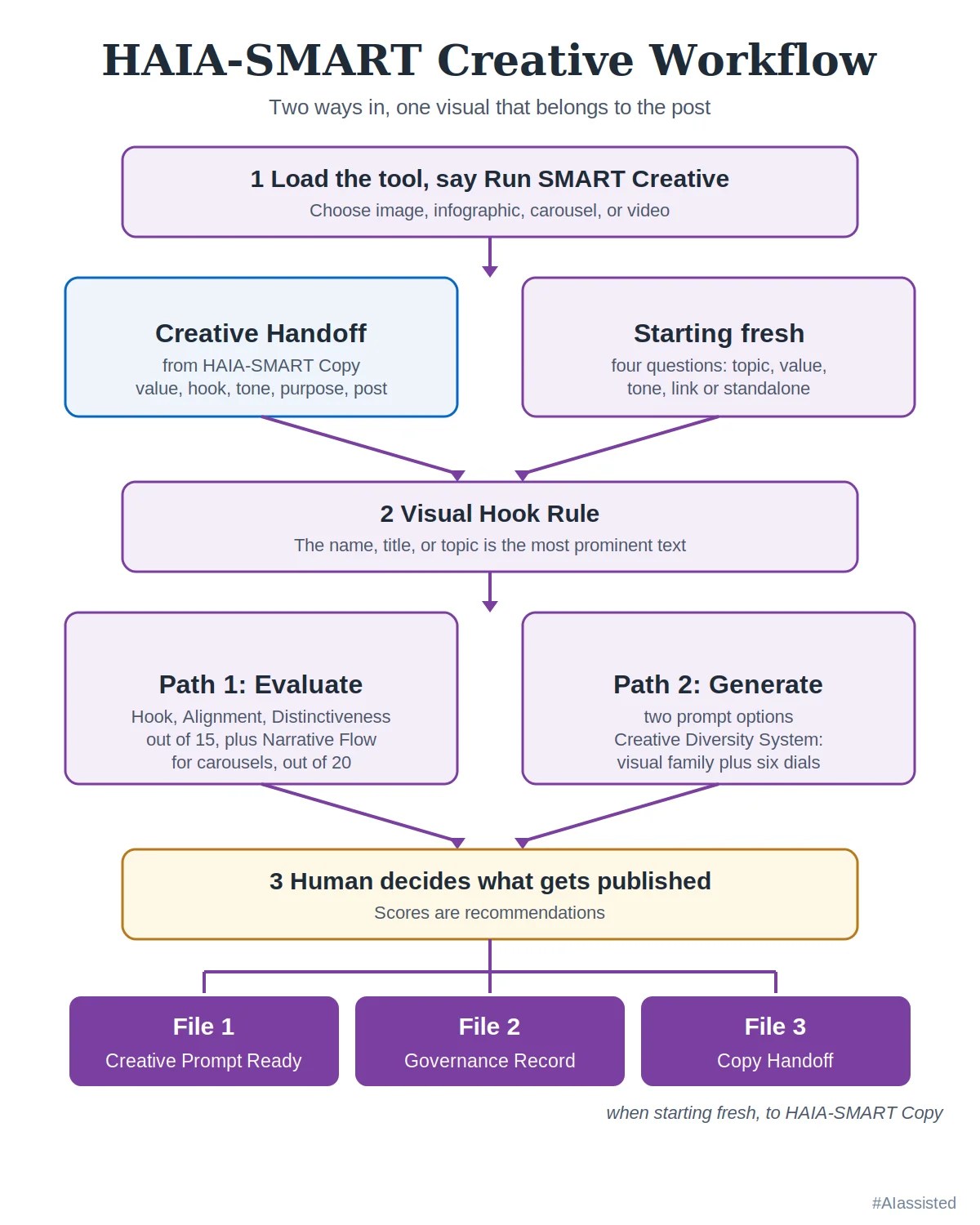
Load the Creative tool and say “Run SMART Creative.” The tool asks what the author needs, whether an image, an infographic, a carousel, or a video brief, and whether a Creative Handoff from SMART Copy is ready.
One rule comes before any score. The Visual Hook Rule requires the name, title, or exact topic of the content to be the most prominent text in the visual, so a reader who sees only the image knows what the post is about.
| Criterion | What it asks |
|---|---|
| Visual Hook Prominence | Does the name, title, or topic dominate the visual? |
| Message Alignment | Does the visual reinforce the post’s core message? |
| Visual Distinctiveness | Does the creative carry its own identity, or does it default to generic clichés? |
| Narrative Flow (carousels) | Does the carousel move from a hook slide through alternating content to a clear close? |
Images and infographics score out of 15, and carousels score out of 20. When the author needs a new visual instead, the tool writes two paste-ready prompts, and the Creative Diversity System keeps them from looking alike. The post’s value type picks a visual family, and six dials for color, typography, composition, density, texture, and format change on every run.
How the Two Tools Connect
The handoff runs in both directions. When Copy runs first, its Creative Handoff carries the post’s value type, hook, tone, purpose, and full text into Creative, so nothing needs explaining twice. When the visual comes first, Creative returns a Copy Handoff with the asset type, visual hook text, tone, and a summary of the image, so the words that follow match what the reader sees.
Both tools also run on platforms that cannot create files, save projects, or remember an earlier chat. On those platforms the author pastes the tool into each new conversation, and the files arrive as labeled text blocks.
What It Does Not Do
It does not detect AI. Human Voice and Visual Distinctiveness describe the writing and the image, not who or what produced them. A person can write defaulted prose, and an author who directs a generated draft until it reads as theirs can score well.
It does not fact-check. The Factics grounding check confirms that a claim has the structure of a grounded claim, and the author stays responsible for whether that claim is true.
It does not publish, and it does not decide. Scores are recommendations, and the approval belongs to a person every time.
Where It Fits in HAIA
SMART sits among the content tools in the HAIA ecosystem, and it applies the discipline the core frameworks establish to the narrow job of a social post.
- Factics comes first. Every claim carries a fact, an action, and a measure, and SMART checks a post for that structure before it scores anything.
- Checkpoint-Based Governance supplies the stop. SMART produces nothing for publication until a person approves the revision.
- HAIA-RECCLIN governs each run, with the AI working in the Editor role unless the person assigns another.
Basil C. Puglisi built HAIA-SMART and first created it on October 7, 2025, with the original commit in the public HAIA repository on GitHub. Melonie Dodaro, LinkedIn Strategist, is credited as Subject Matter Contributor, and her testing informed the September 2026 revision of SMART Copy.
Get the Tools
HAIA-SMART Copy: The Social Media AI Rating Tool, and Why Good Posts Still Go Unread
The complete Copy paper and tool, covering the six pillars, both modes, the eight platform deliverables, and the full prompt ready to copy.
Download SMART Copy as a PDF
Version 2.1, September 2026.
SMART Copy Tool on GitHub
The .md file, ready to load into any AI project or chat.
HAIA-SMART Creative: The Social Media AI Rating Tool, and Why Every AI Visual Looks the Same
The complete Creative paper and tool, covering the Visual Hook Rule, scoring, the Creative Diversity System, and the full prompt ready to copy.
Download SMART Creative as a PDF
Version 2.1, September 2026.
SMART Creative Tool on GitHub
The .md file, ready to load into any AI project or chat.
Common Questions
What does SMART stand for?
Social Media AI Rating Tool. HAIA is the ecosystem it belongs to, the Human Artificial Intelligence Assistant.
Does it cost anything?
No. Both tools are free for personal, educational, and noncommercial research use under CC BY-NC-SA 4.0 with attribution, and commercial use requires separate permission and licensing.
Do both tools have to run together?
No. Each tool runs on its own, with SMART Copy covering the words and SMART Creative covering the visual, and the handoff files connect them when a post needs both.
Which AI platforms can run it?
Any AI chat that accepts a prompt. The tools load into a project, attach to a chat, or paste into a conversation, and on platforms without file creation or memory, the files come back as labeled text blocks.
Does SMART detect AI-written posts?
No. The scores describe the writing and the visual, not who produced them. The goal is prose and images that read as directed by a person, which is something any author can fix.
Why does every post end with #AIassisted?
The exact tag #AIassisted is the one condition of using HAIA-SMART. It records that AI assisted under human review and stays on every post the tool produces, while first comments carry no tag. An author who does not want that attribution on published posts should not use the tool.
Basil C. Puglisi, MPA
A Human-AI Collaboration
#AIassisted using the HAIA Ecosystem | CC BY-NC-SA 4.0
Free for personal, educational, and noncommercial research use with attribution. Commercial exploitation, paid productization, and enterprise commercialization require separate permission and licensing.