• Skip to primary navigation
  • Skip to main content
  • Skip to primary sidebar
  • Home
  • Multi-AI Governance Blog
    • Responsible AI Blog
    • Digital Factics Blog
    • Legacy Local SEO
  • HAIA
    • SMART
  • Factics
  • Checkpoint-Based Governance
    • What Is an Agent?
  • RECCLIN
  • CAIPR
  • HEQ/AIS
    • AIS pilot data test
  • AI Policy
    • ISO AI Governance Comment

Basil C. Puglisi

Artificial Intelligence (AI) & Digital Marketing Since 2009

  • About Me
    • My Story
      • Appearances for Speaking
  • The Minds That Bend The Machine
  • Governing AI
  • Digital Factics X
  • Digital Factics Instagram
  • AI – Artificial Intelligence
    • Ethical AI – Disclosure
    • AI Literacy & Education
    • AI Learning
      • AI Course Descriptions

Google Search goes social with +1

April 1, 2011 by Basil C. Puglisi Leave a Comment

While Google may cover around thirteen percent of US display in online advertising marketing, Facebook may garner around twenty-two percent. Not surprisingly, it seems like Google has decided they actually do like the way Facebook allows users to share their interest, recommendations and ideas. So they have now added their own method of ‘liking’ or upvoting favored websites and other content. This method for helping to endorse chosen content and search results gives Googlers just one more way to endorse the products and services they enjoy.
Along with the recent algorithm change, Google execs say this is just one more way that they are heading off the pass between low-quality and irrelevant search engines results to see that their search engine queries cultivate the most useful and helpful websites that pertain to a users search results, and as quickly as possible. 

The Google Experiment

Testing out this new method for yourself is incredibly easy. Just make sure you are logged into your Google account and head to their experimental search page. Select Join this Experiment, and it is on.  If you are already participating in a Google experiment you will need to select the leave option on the current one to join the +1 experience. Now head to Google search and type in a search query. Once your search results appear, next to the title of the page will be a small, mostly blue edged box with a faint +1. Once clicked, the box will now display as solid blue and a text display just under the title will now show that you publicly +1’d a site.
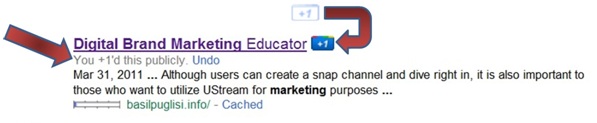
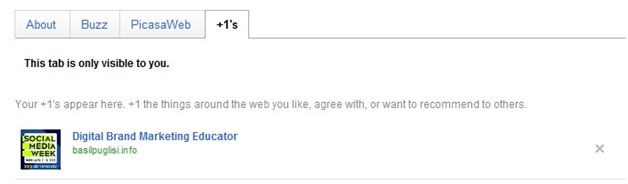
Now those in your Google network only will also be able to see the sites that you have shown your +1 interest in. Additionally, if your friends have been there before you, and +1’d the same link, this will show up as well. Your Google account profile will also save a list of any site you +1 to your account details. For those who utilize their Google and Gmail accounts regularly, this could be a quite helpful tool for saving any site they may have a particular affinity for.
Pros and Cons of Up-Voting

Although for now, the results of +1’s will only be displayed publicly to those in your network, as well as a select random few public +1 voters, it may also be likely that if results from the experiment are positive, a global public will probably be next in their sights.

It is yet to be seen if having ‘friends in high places’ or highly reputable +1’s will make any difference, but it seems highly likely that if Google Labs does take this experiment to the global public, that having top-notch and highly reputable +1 friends could certainly make a huge difference in a web sites own popularity.

With the internet commerce of all types having such a large crowd of competitors this could certainly prove helpful on the local fronts rather quickly. Search engine queries for local businesses will, of course, display far fewer results then queries on a statewide, national or global scale. With far fewer competitors, favored local businesses will likely be quickly noticeable.

While up-voting may in fact give smaller businesses a shot at more public recognition, it may also leave another slot open for SEO tricksters and black-hat marketers to once again send to the top of the +1 pile those with enough resources and techniques to gain those +’s in perhaps not so organic manners.

Google Goes Social

Although quite an attempt was made at sending Google openly into the social media world with the inception of their Google Buzz system, it has had seemingly little effect or impact in the social media marketing world.

Google does plan to integrate their +1 system with Twitter as well, which will add another huge aspect of socially marketing and bookmarking to a users basic browser search results.

[youtube=http://www.youtube.com/watch?v=OAyUNI3_V2c]

Immediate Impact

Although Google has used social media interactions for years in its search engine displayed results, they seem to have definitely monitored and watched for important signals and statistics to give their regular users the ability to help promote more product-centric marketing.

By 4:00pm yesterday, even though shares had fallen by 2% this year, Google had risen by 11 cents to $581.84 per share on the Nasdaq.

Sources:

  • AdWeek
  • Bloomberg
  • CNet
  • CNN Money
  • Mashable
  • TechCrunch

Share this:

  • Share on LinkedIn (Opens in new window) LinkedIn
  • Share on Facebook (Opens in new window) Facebook
  • Share on Mastodon (Opens in new window) Mastodon
  • Share on Reddit (Opens in new window) Reddit
  • Share on X (Opens in new window) X
  • Share on Bluesky (Opens in new window) Bluesky
  • Share on Pinterest (Opens in new window) Pinterest
  • Email a link to a friend (Opens in new window) Email

Like this:

Like Loading…

Related

Filed Under: Branding & Marketing, Conferences & Education, Digital & Internet Marketing, Digital Factics Blog, SEO Search Engine Optimization, Social Brand Visibility, Social Media Topics Tagged With: adwords, analytics, brand, google, SEO, Social Brand, Social Media, Social Media Social Brand Visibility, Visibility, Visibility Marketing

Subscribe to Blog via Email

Enter your email address to subscribe

Join 9,585 other subscribers

Reader Interactions

Comments

  1. 'Maven in the Hat! says

    April 2, 2011 at 8:57 am

    Thank you Basil for the fascinating article. I am going to give the new Google ‘+1’ a try. We need to continue the discussion also about blogging together.

    Loading...
    Reply
  2. 'Maven in the Hat! says

    April 2, 2011 at 10:27 am

    I wanted to follow up and let everyone know that I have added +1 to my Google profile. It is fun and easy to use. Of course, it is much too soon to say if Google +1 = facebook ‘LIKE’page. But the way I see it, the more ways to communicate, the better. I am not invested in who is more popular or who’s stock is at what % higher or lower. I like both Google and facebook. In fact, I like it all even though it often feels like driving without any lessons.

    Loading...
    Reply
  3. Jane Oliver says

    October 3, 2011 at 9:44 pm

    Why did you even bother writing this article? LeBron isn’t even newsworthy anymore…he hasn’t been for awhile

    Loading...
    Reply
    • Basil C. Puglisi says

      October 4, 2011 at 1:12 pm

      Hmm, how or what do you mean?

      Loading...
      Reply

Trackbacks

  1. Does Google +1 = facebook ‘LIKE’ page? « Alison*s MARKETING BYTES Blog says:
    April 2, 2011 at 9:33 am

    […] I am going to give it a try and wanted to give my readers the opportunity to do so as well. The instructions on how to use Google +1 are in Basil’s blog entitled, Google Search goes social with +1. […]

    Loading...
    Reply
  2. Google is Still Winning – But For How Long? « Digital Brand Marketing Educator says:
    April 15, 2011 at 10:03 am

    […] to rise. However, Google continues to fill up their handy box of tricks with new features such as +1, Google Instant, and their social search, as well as their ability to block unwanted […]

    Loading...
    Reply
  3. The PR State of Facebook « Digital Brand Marketing Education says:
    May 17, 2011 at 10:42 am

    […] sign that Facebook executives are worried about recent Google social marketing elements such as the +1 system? Will their willingness to execute black hat behaviors cost them enough users to matter? Unlikely, […]

    Loading...
    Reply
  4. Google Throws Down the Gauntlet at Facebook in Social Network Struggle « Digital Brand Marketing Education says:
    June 29, 2011 at 7:56 pm

    […] Google Search goes social with +1 […]

    Loading...
    Reply

Leave a Reply Cancel reply

You must be logged in to post a comment.

Primary Sidebar

Subscribe via Email

Join 9,585 other subscribers
iDBasil C. Puglisi on ORCID

How to Learn About AI

The Minds That Bend the Machine by Basil C. Puglisi, MPA. Book promotion exploring artificial intelligence, bias, power, and humanity. Releases November 6, 2026.

Buy the eBook on Amazon

This is an banner ad for the book Governing AI When Capability Exceeds Control
Buy the book Digital Factics on Amazon

Advanced Site Search

Responsible AI (#AIgenerated by Agents)

NIST’s Agent Identity Tenets Warn That Human Review Can Turn Into Habit #AIg

NIST’s ten design tenets for agent identity management put most controls in infrastructure and send risky actions to human review. Tenet 05 warns that frequent escalation can turn approval into habit, and leaves who rules, and what record that ruling leaves, to each organization.

India’s Telecom Regulator Would Require a Designated Officer’s Approval Before Any AI System Is Used #AIg

TRAI’s draft guidelines on responsible AI in telecom would require a designated officer to approve every AI system before use and make operators accountable for vendor-built AI. They say less about who rules on outputs once a system is running. Comments are due November 27.

Only a Quarter of UK Workers Always Verify AI Answers. Who Decides Which Ones Count? #AIg

O’Reilly found that only 24% of UK employees always verify AI-generated answers, and 39% of those using them have acted on one that proved wrong. Perceptyx and RGP point to the missing piece: deciding which AI outputs need a named person’s ruling.

New AI Certificates for Doctors and Teachers Teach Checking. Do They Certify It? #AIg

Google launched an AI certificate for healthcare professionals that takes under five hours and carries up to 5.0 CME credits, and Scale and UMSL launched a 12-hour microcredential for teachers. Both teach evaluation of AI output. A European teacher framework asks for evidence of it, and employers can too.

OpenAI Built Four Layers to Watch Its Agents. Human Paging Mostly Keeps Business Hours #AIg

OpenAI’s October 29 post describes up to four automated layers that watch its agents, then discloses that human paging runs at any hour only for highest-priority alerts on frontier training runs, during business hours for most other traffic, and is currently off for internal Codex. For enterprise deployments, alerts go to the customer’s own webhook, and on our reading so does the decision.

House Democrats Ask AI Labs for Incident Reports Within 48 Hours of Discovery #AIg

Letters dated October 27 ask five frontier AI companies for a full accounting of misalignment incidents by November 11 and notice within 48 hours of discovery. None of the fourteen requested items asks who inside a company decides a flagged event is an incident, and that decision is what starts the clock.

A New Jersey Bill Takes Reasonable Care Off the Table for Chatbot Injuries #AIg

New Jersey’s A5607, reported out of committee on October 19, would make a chatbot a product and hold its provider liable for any injury to a user from its use, even after all reasonable care. The monthly harm assessment it requires still needs a named person to decide what the numbers mean.

More Posts from this Category

#SMAC #SocialMediaWeek

Basil Social Media Week

Legacy Print:

Digital Factics: Twitter

© 2009–2026 Basil C. Puglisi, Creator of Factics™ and the HAIA Ecosystem

%d