According to statistic reports, as of January 2011, the 4 year old site Tumblr.com has 20,873,182 users. For the same period WordPress.com, the older site (by 4 years), announced they have 20,787,904 websites powered by wordPress.com
This is the first time anybody overtook WordPress.com, and it became kind of big news among the blogosphere. To set the record straight, it is important to note that WoldPress.com numbers do not include the open sourced blog platform WoldPress.org, where people have websites they host themselves. The comparison is between the two hosting blog platforms only.
Still, it is clear that many individuals have been signing with Tumblr more than they have been signing with WordPress.com. Which one is better? Well, that depends on why you want a site or a blog and what you want to include in it.
What do they have in common?
- Both are free.
- Each site has free themes which can be easily installed.
- Both can be customized.
- Both can be updated from any computer or device that has internet connection.
- Both allow you to name your page the way you choose.
- Both are well known and popular, with good reputation.
- Both have export capabilities. If you want to move your site, you can.
- Both allow importing content from other content management systems.
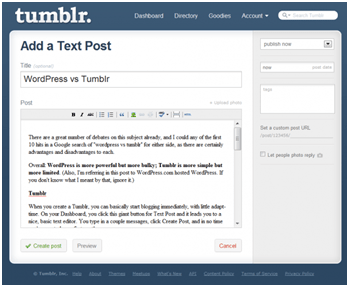
Tumblr
Ease of use –
- No installation or configuration of the program on your computer is needed.
- User friendly dashboard
- Easy upload of multimedia files
- Custom designs (which do require payment) are cheaper on Tumblr than on WordPress
- Easy to update from a mobile device
- Has a built in community functions that allows following like-minded bloggers, reblogging what they wrote and “liking” it, which makes Tumblr a more community oriented site.
Functionality –
- The server cannot be controlled by the user; it has to be hosted by the site. However, you can use a unique url that does not include .tumblr at the end.
- The user has complete control over the content and can move his site or blog to another platform.
Design and customization
- Has one basic layout and it must be applied to every page on the site. They now added page support to make the navigation between pages much easier.
- Supports only 3rd party calendars and contacts, but it requires knowledge in coding.
Social Integration –
- Built in. You can post and link to twitter automatically. You can also connect it to your Facebook page.
WordPress
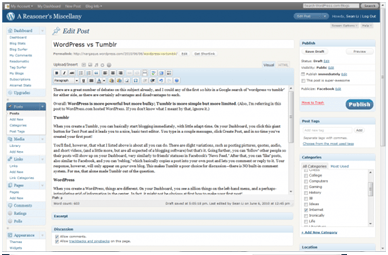
Ease of use –
- Downloading their program is necessary, but it offers many more options and settings.
- The design and functionality of the page is more cumbersome and requires some learning.
- Allows multiple pages, download of plug-ins, widgets and sidebars.
Functionality –
- With WordPress.com the user has to use their server. WordPress.org supports sites hosted by another server.
- The site can be easily expanded to replace the current site.
- People who have not designed the site but have administrative rights can post on the site without much effort.
Design and customization –
- Many page layout options.
- Ability to use different layouts for different pages.
- Allows including native calendars and contact forms.
Social integration –
- Can be done with the help of plug-ins.
- WordPress.com has publisize allowing for sharing with Facebook Pages, Twitter, Yahoo, etc..
The ongoing consensus among experts is that Tumblr is more user friendly, fun and easy to blog. Its design is slick and simple, modern and big. It is geared more toward pictures and media than WordPress.
Both can be customized but WordPress is more extensive and flexible. If you don’t need an extensive e commerce site with forms, listings, heavy content and advertising, Tumblr is simpler.
But the biggest difference is in the ease of social integration on Tumblr that is built in, while it has to be added to WordPress.com with different plug-ins. Tumblr functions as a cross between a website and a Facebook profile, while WordPress is more dry and functional.
Some companies in entertainment, news and fashion have blogs through Tumblr. The Washington Post Innovations, Newsweek, The Huffington Post and Rolling Stones are some examples. Musicians and photographer seem to flock to Tumblr as well.
WordPress.com hosts sites of top brands like CNN, National football league and TED.

Sources:
Superb read, I just passed this onto a colleague who was performing a little research on that. And he really bought me lunch as I discovered it for him smile So let me rephrase that: Thank you for lunch!
The problem with wordpress is they’re unreachable. There is no way to reach them via phone and very often they don’t even respond to e-mail. For all I know WordPress may just be a computer program and not a single living, breathing soul is even remotely attached to it.
This is very sad. Yes, WordPress has a lot of features and has many attributes, but not being able to interact with a human being is frightening.Even if one attempts to find the devlopers of WordPress, he or she will only find – developed by WordPress Foundation – spooky. Is WordPress run by “Hal 9000” (Stanley Kubrick’s film and Arthur Clark’s Sci.Fi. novel both entitled – 2001 Space Odyssey)
As I take my tongue out of my cheek, I just wish Matt Mullenweg, the human developer had people we regular folks could talk to. I know having a customer service department would cost millions of dollars but… help us. .
Here is my contact information:
e-mail: whadawethink@hotmail.com
web site: http://www.whadawethink.com
Phone # 516-409- 9001 See I’m not afraid to post myt #. Call me and you will get me.
Mike,
You know you have a point, when I attended BlogWorld at the Javits Center in NYC there was a huge area for this lounge style booth with 15 people at it, it was for WordPress and Automatic. The issue was they ahd a tremendous amount of people that were working on .com and the booth staff were constantly explaining they have nothing to do with that….
Basil