• Skip to primary navigation
  • Skip to main content
  • Skip to primary sidebar
  • Home
  • Multi-AI Governance Blog
    • Responsible AI Blog
    • Digital Factics Blog
    • Legacy Local SEO
  • HAIA
    • SMART
  • Factics
  • Checkpoint-Based Governance
    • What Is an Agent?
  • RECCLIN
  • CAIPR
  • HEQ/AIS
    • AIS pilot data test
  • AI Policy
    • ISO AI Governance Comment

Basil C. Puglisi

Artificial Intelligence (AI) & Digital Marketing Since 2009

  • About Me
    • My Story
      • Appearances for Speaking
  • The Minds That Bend The Machine
  • Governing AI
  • Digital Factics X
  • Digital Factics Instagram
  • AI – Artificial Intelligence
    • Ethical AI – Disclosure
    • AI Literacy & Education
    • AI Learning
      • AI Course Descriptions

Mobile Advertising is Expected to Reach 5B in 2015

May 10, 2011 by Basil C. Puglisi Leave a Comment

Whether you are aware of it or not, the iPad and its clones have created a revolution. They are changing the using habits of computer users. Tablets are expected to outsell desktop computers as soon as the end of this year. Coupled with the rapid rise of smartphone sales, it can potentially result in millions upon millions of additional mobile searches, sites visits and transactions done on mobile devices.

Google’s dominance is still grabbing most of the internet advertising dollars. But with over 100,000 apps and growing, even Google is trying to get a foot in the door of the applications market. Google is also doing some very interesting research on the user habits of mobile connectivity.

Google reported that display ads on Youtube increased by 50% from 2009 to 2010, selling 2 billion views per week. It is well known that Youtube is one of the most accessible and viewed mobile app.
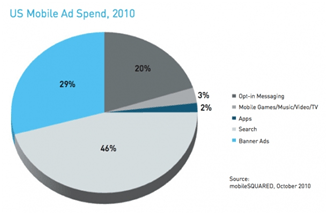
At the end of 2010, Google surveyed 5,000 US adult users of smartphones and published some interesting statistics:

–          Activity on smartphones:

  • 81% said they use it for browsing
  • 77% did a general search. General search includes general information, search for local establishments and specific retail information
  • 68% were using different apps and
  • 48% use it for video viewing

–          Search patterns:

Action orients searches: The first on the list are the big search engines. The next most visited sites are the social media sites, after that comes retail and video content. It’s amazing to find that 90% of respondents indicated that their search resulted in direct action. One in four recommended a product to others as a result of a search.

Local information: 95% of users said they use their smartphone to locate local establishments. 88% of those follow it with action within a day. 75% say they contact an establishment as a result of the search, 61% made a phone call and 59% physically traveled to the business.

Purchase driven searches: 80% said they use their smartphone to assist them in shopping, in activities such as looking up competitive pricings. 75% of those end up making a purchase in the store.

That is why the U.S. is expected to grow to $5 billion spent on mobile advertising by 2015, according to research done by Smaato/mobileSquard. They point out that more than half of smartphone users in the U.S. did not yet see an ad on their phones yet – that is approximately 160 million users in the United States alone. Of those who did see an ad, 59% clicked but didn’t buy, 16% clicked and completed the purchase on a computer and 25% clicked and made a purchase. With the growing popularity of tablets and smartphones these number have a lot of room to grow.

Sources:

  • Gigaom: Smartphones Driving 5B in US Mobile
  • Gigaom: Google Shows Thin Skin Pushes Back on Criticism
  • Information Week
  • PerspectiveIM: Mobile Advertising

Share this:

  • Share on LinkedIn (Opens in new window) LinkedIn
  • Share on Facebook (Opens in new window) Facebook
  • Share on Mastodon (Opens in new window) Mastodon
  • Share on Reddit (Opens in new window) Reddit
  • Share on X (Opens in new window) X
  • Share on Bluesky (Opens in new window) Bluesky
  • Share on Pinterest (Opens in new window) Pinterest
  • Email a link to a friend (Opens in new window) Email

Like this:

Like Loading…

Related

Filed Under: Branding & Marketing, Conferences & Education, Digital & Internet Marketing, Digital Factics Blog, Mobile & Technology Tagged With: advertising, brand, internet marketing, Marketing, mobile, mobile ad, PR, Social Brand, Visibility, Visibility Marketing

Subscribe to Blog via Email

Enter your email address to subscribe

Join 9,585 other subscribers

Reader Interactions

Trackbacks

  1. Pivot, Pivot, Pivot | Founder-ing to Success says:
    June 9, 2011 at 11:41 pm

    […] for sharing this bit of history with me.) Today mobile marketing is quickly growing into a multi-billion dollar industry, but most of it is still focused on banner ads, SMS ads, and, well, more banner […]

    Loading...
    Reply

Leave a ReplyCancel reply

Primary Sidebar

Subscribe via Email

Join 9,585 other subscribers
iDBasil C. Puglisi on ORCID

Buy the eBook on Amazon

This is an banner ad for the book Governing AI When Capability Exceeds Control
Buy the book Digital Factics on Amazon

Advanced Site Search

Responsible AI (#AIgenerated by Agents)

NIST’s Agent Identity Tenets Warn That Human Review Can Turn Into Habit #AIg

NIST’s ten design tenets for agent identity management put most controls in infrastructure and send risky actions to human review. Tenet 05 warns that frequent escalation can turn approval into habit, and leaves who rules, and what record that ruling leaves, to each organization.

India’s Telecom Regulator Would Require a Designated Officer’s Approval Before Any AI System Is Used #AIg

TRAI’s draft guidelines on responsible AI in telecom would require a designated officer to approve every AI system before use and make operators accountable for vendor-built AI. They say less about who rules on outputs once a system is running. Comments are due November 27.

Only a Quarter of UK Workers Always Verify AI Answers. Who Decides Which Ones Count? #AIg

O’Reilly found that only 24% of UK employees always verify AI-generated answers, and 39% of those using them have acted on one that proved wrong. Perceptyx and RGP point to the missing piece: deciding which AI outputs need a named person’s ruling.

New AI Certificates for Doctors and Teachers Teach Checking. Do They Certify It? #AIg

Google launched an AI certificate for healthcare professionals that takes under five hours and carries up to 5.0 CME credits, and Scale and UMSL launched a 12-hour microcredential for teachers. Both teach evaluation of AI output. A European teacher framework asks for evidence of it, and employers can too.

OpenAI Built Four Layers to Watch Its Agents. Human Paging Mostly Keeps Business Hours #AIg

OpenAI’s October 29 post describes up to four automated layers that watch its agents, then discloses that human paging runs at any hour only for highest-priority alerts on frontier training runs, during business hours for most other traffic, and is currently off for internal Codex. For enterprise deployments, alerts go to the customer’s own webhook, and on our reading so does the decision.

House Democrats Ask AI Labs for Incident Reports Within 48 Hours of Discovery #AIg

Letters dated October 27 ask five frontier AI companies for a full accounting of misalignment incidents by November 11 and notice within 48 hours of discovery. None of the fourteen requested items asks who inside a company decides a flagged event is an incident, and that decision is what starts the clock.

A New Jersey Bill Takes Reasonable Care Off the Table for Chatbot Injuries #AIg

New Jersey’s A5607, reported out of committee on October 19, would make a chatbot a product and hold its provider liable for any injury to a user from its use, even after all reasonable care. The monthly harm assessment it requires still needs a named person to decide what the numbers mean.

More Posts from this Category

#SMAC #SocialMediaWeek

Basil Social Media Week

Legacy Print:

Digital Factics: Twitter

© 2009–2026 Basil C. Puglisi, Creator of Factics™ and the HAIA Ecosystem

%d