• Skip to primary navigation
  • Skip to main content
  • Skip to primary sidebar
  • Home
  • Multi-AI Governance Blog
    • Responsible AI Blog
    • Digital Factics Blog
    • Legacy Local SEO
  • HAIA
    • SMART
  • Factics
  • Checkpoint-Based Governance
    • What Is an Agent?
  • RECCLIN
  • CAIPR
  • HEQ/AIS
    • AIS pilot data test
  • AI Policy
    • ISO AI Governance Comment

Basil C. Puglisi

Artificial Intelligence (AI) & Digital Marketing Since 2009

  • About Me
    • My Story
      • Appearances for Speaking
  • The Minds That Bend The Machine
  • Governing AI
  • Digital Factics X
  • Digital Factics Instagram
  • AI – Artificial Intelligence
    • Ethical AI – Disclosure
    • AI Literacy & Education
    • AI Learning
      • AI Course Descriptions

Loopt: A Social Location Tool

April 26, 2011 by Basil C. Puglisi Leave a Comment

Let’s say you step out of class or a business meeting or a long day at work, and you wonder; where are my friends right now and what are they up to? What fun activity am I missing?

Loopt, a mobile application, helps you see a clear picture of your social circle, without making a round of calls or texts. This virtual social application is meant to be a facilitator of the real social world.

Founded in 2005 and launched in 2008 as an iPhone app, Loopt is growing and incorporating other social media platforms. In January 2011 the site came up with a 4.0 update that changed the look, added new features and is applicable on all smart phones. At the moment, Loopt has more than 4 million users and have partnerships with Google Maps, Facebook Places and Twitter, among others.

Their application lets you see at a glance and in real time where your friends are hanging out. It will show you who is at a nearby place and wants company. It will show you where is this new place everyone is talking about and who’s there. You can text your friends and get a map how to get there.

Another service they provide are recommendations to places you have never been before. If you are on a business trip, in a new city, wouldn’t you want to get first hand recommendations about places to eat or hang out? Again, you might meet a tall dark stranger who is on your network of virtual friends.

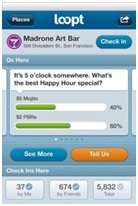
In the latest update, out in April 2011, you can get at-a-glance recommendations about a place. Let’s face it, say the makers of Loopt. Most of the remarks are either very good – people loved it enough to write about it, or very bad – they were really unhappy with something. Who has the time to go through all those posts? Their Loopt Q, lets you see it in a graph form. Good reviews vs. bad ones. You don’t have to stand outside a restaurant for half an hour and read all the posts. This service is now available only in San Francisco, with a plan to roll it soon to other cities as well.
Sources:

  • Crunchbase
  • Blog.Loopt
  • Loopt
  • ReadWriteWeb
  • Wikipedia

Share this:

  • Share on LinkedIn (Opens in new window) LinkedIn
  • Share on Facebook (Opens in new window) Facebook
  • Share on Mastodon (Opens in new window) Mastodon
  • Share on Reddit (Opens in new window) Reddit
  • Share on X (Opens in new window) X
  • Share on Bluesky (Opens in new window) Bluesky
  • Share on Pinterest (Opens in new window) Pinterest
  • Email a link to a friend (Opens in new window) Email

Like this:

Like Loading…

Related

Filed Under: Branding & Marketing, Conferences & Education, Digital & Internet Marketing, Digital Factics Blog, Social Brand Visibility, Social Media Topics Tagged With: brand, FourSquare, Location, Marketing, mobile, Social Brand, Social Media, Visibility, Visibility Marketing

Subscribe to Blog via Email

Enter your email address to subscribe

Join 9,585 other subscribers

Reader Interactions

Leave a Reply Cancel reply

You must be logged in to post a comment.

Primary Sidebar

Subscribe via Email

Join 9,585 other subscribers
iDBasil C. Puglisi on ORCID

How to Learn About AI

On-sale-now promotion for The Minds That Bend the Machine by Basil C. Puglisi, MPA, featuring the hardcover, a glowing digital human profile and globe, and a $29.99 hardcover release price. Kindle edition $19.99.

Buy the eBook on Amazon

This is an banner ad for the book Governing AI When Capability Exceeds Control
Buy the book Digital Factics on Amazon

Advanced Site Search

Responsible AI (#AIgenerated by Agents)

Australia’s Planned Frontier AI Incident Reporting Still Depends on a Decision Inside Each Company #AIg

Australia announced mandatory protections for frontier AI companies, including a regulator, independent evaluation, and rapid incident notification. Each obligation still depends on a named person inside the company who classifies, signs, and decides whether to continue.

Courts Are Ordering AI Chat Histories Produced, and Deletion Logs Are Now in Dispute #AIg

A Florida federal court allowed discovery of a defendant’s AI conversations in a damages dispute and then ordered consent for providers to release deletion logs. Retention tools are Responsible AI, and the records decision belongs to a named human under AI Governance.

A Draft Taxonomy of Attacks on AI Agents Leaves Risk Tolerance to Each Organization #AIg

NIST’s November 9 draft taxonomy of attacks on AI agents says guardrails must face adaptive attackers, yet it sets no risk tolerance. Each organization needs a named human to sign the residual risk decision for every relevant attack type.

A UK Bill Clause on AI Agent Loss of Control Assumes Someone Held the Control. Can You Show Who? #AIg

The UK government tabled a clause letting regulations give ministers investigatory and enforcement powers when a regulated system’s compromise traces to loss of control of an AI agent. A loss-of-control rule assumes someone held control, so operators should be able to show who held stop authority before any incident.

Europe Plans to Assess AI Literacy in 15-Year-Olds. Who Holds the Checkpoint at School? #AIg

The European Commission will pilot an AI Literacy Certificate for 15-year-olds in the 2027/2028 school year. The framework behind it teaches pupils to set their own checkpoints; the school still needs a named person who signs which AI tools pupils use.

NIST’s Ten Agent Identity Tenets: What Checkpoint-Based Governance Already Carried

NIST published ten agent identity tenets on October 27, 2026. Nine were already in a public record that began in 2012.

This article lays the ten tenets against Checkpoint-Based Governance, the February 2026 GOPEL specification and code, and the Responsible AI desk that was publishing before the tenets appeared. Five match in full, four in part, and one, the agent’s own credential, is defined in the record and not yet issued. The reader gets the dates, the quotes, and the table to check them.

When an Agent Acts, Who Confirms Before the Kernel Lets It Through? #AIg

Sysdig AI Defense generally available on November 4 puts allow, confirm, or block in front of every agent action, traces each agent to an accountable human, and keeps audit records of who signed off. Conduktor and Google Cloud land the same week on human approval and sandboxed containment.

More Posts from this Category

#SMAC #SocialMediaWeek

Basil Social Media Week

Legacy Print:

Digital Factics: Twitter

© 2009–2026 Basil C. Puglisi, Creator of Factics™ and the HAIA Ecosystem

%d