The Following Article was published in response to a issue raised in with two Real Estate brands in the Hamptons. It is issues like these that are at the heart of this publication and its mission. “It is my hope that when someone isn’t sure about digital media or the information that has been presented to them, they can turn to this blog as a source to verify or self educate so that they can make better more informed decisions”.
Saunders to Give Back Two Domain Names to Non-Saunders Agents published in 27East.com
ICANN – Internet Corporation for Assigned Names and Numbers
To reach another person or a company on the internet you have to type a name or a number as an address into your computer. This address has to be unique so computers can find each other. Who regulates it and decides on a uniform system? Who decides who owns what?
From the start there were a few known addresses called top level domain (TLD); .COM, .NET, .ORG, .EDU and endings which denote countries: .UK, .FR, .LI (Libya) or .IL (Israel). These are called country code top level domains.
Up until September 1998, the United States Government completely controlled the system. The entity which supervised the internet was called IANA – Internet Assigned Numbers Authority.
As the internet grew and became more commercial and wide spread, the US control became increasingly untenable. The Clinton Administration was looking for a way to make the governance of the domain system global and free. One option was to hand over control to the UN, and indeed the UN pushed to have that authority under its International Telecommunication’s Union, but the Clinton Administration decided to privatize the domain name governance. It did so to keep the web’s critical system away from political influence and stifling bureaucrats.
The ICANN – Internet Corporation for Assigned Names and Numbers, a non-profit corporation was established. It was commissioned to oversee a number of internet related issues; managing the internet protocol address, assigning regional internet registries for countries, maintaining registries of internet protocol identifiers, management of top level domain names space and introduction of new generic top-level domains. Their principles call for helping preserve the operational stability of the internet, promote competition, and have a broad representation of the global internet community.
ICANN is located in Marina Del Ray, California, and remains in the same building where it started at the University of Southern California. Jon Postel who thought about an entity like that and was set to be the first CTO, died unexpectedly at the age of 55 before he saw it come to life.
At present ICANN is managed by a board of directors, composed of six representatives of sub groups that deal with specific section of the ICANN charter. They are supported by 3 organizations: the Generic Names Supporting Organization who deals with policy regarding generic top level domain, the County Code Names Support Organization and the Address Supporting Organization who deals with policy on IP addresses. There are advisory committees on different subjects like risk, finance, global relationships, IANA and structural improvements.
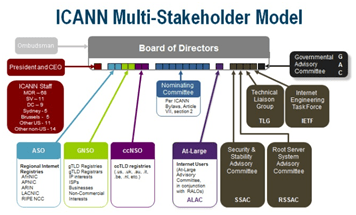
ICANN doesn’t control content and it can’t stop spam. It does not deal with access to the internet.
ICANN holds public meetings rotated between continents to encourage global participation in its processes. The resolutions, reports, and minutes of meetings are published on the ICANN website. In September 2006, ICANN signed a new agreement with the US Department of Justice for another 5 years.
Uniform Dispute Resolution Policy
One task the ICANN was asked to do is ownership dispute resolution for generic top level domains. Together with the World Intellectual Property Organization it drafted a policy that is known as Uniform Dispute Resolution Policy. This policy attempts to provide a mechanism for a fast, cheap and reasonable resolution of domain name conflicts, avoiding the traditional court system and relying on arbitration. According to their policy a domain registrant agrees, when he signs the domain contract, to be bound by the resolution of the arbitration.
The UDRP currently applies to .BIZ, .COM, .INFO, .NAME, .NET and .ORG and some country code top-level domains.
A complaint has to establish 3 elements:
- The domain name is confusingly similar or identical to a trademark or service mark in which the complainant has the right to.
- The registrant has no right or legitimate interest in the domain name.
- The registration was done in “bad faith”.
A single arbitrator or a panel of three arbitrators will consider factors such as whether the domain was registered in order to be resold, rented or transferred to the owner of the trademark; whether the domain name was registered to prevent the owner from registering corresponding domain name, whether it was registered primarily for the purpose of disrupting a competitor or whether, by using the domain name, the registrant attempted to attract internet users for commercial gain, creating a likelihood or confusion.
Those services come at a price; from $1,500 for a single arbitrator to $5,000 for a panel. A very long list of the disputes brought to them is published on their wesite.
Much of the published arbitration has to do with famous cases: Madonna v. Dan Parisi who registered the domains MadonnaCiccone.com and Madonna.com. He was ordered to turn over the domain names to Madonna.
Robert de Niro claimed ownership for all domain names that include the word Tribeca plus any content related to the film festival. His dispute was with a domain called Tribeca.net. Rihanna.com came up for sale and the legal team of the singer filed a UDRP. Other famous arbitrations were conducted regarding ElitrModels.com, WWF.com and AirDeccan.com. All the information about procedures and timelines can be found here: http://www.icann.org/en/udrp/udrp.htm
There are other entities approved by ICANN which provide UDRP services: World Intellectual Property Organization, National Arbitration Forum, Asian Domain Name Dispute Resolution Centre and the Czech Arbitration Court Arbitration Center for Internet Disputes.
All their sites detail the procedures, timelines and prices.

Sources:
Basil,
I am Britta’s man so we have met before. I’d like to discuss some business with you when you get a chance, please call me. Thanks!
-Tommy Hill
(917) 620.3897
Good info, Basil, and I agree very important that people have resources to easily turn to for accurate, up-to-date information.