• Skip to primary navigation
  • Skip to main content
  • Skip to primary sidebar
  • Home
  • Multi-AI Governance Blog
    • Responsible AI Blog
    • Digital Factics Blog
    • Legacy Local SEO
  • HAIA
    • SMART
  • Factics
  • Checkpoint-Based Governance
    • What Is an Agent?
  • RECCLIN
  • CAIPR
  • HEQ/AIS
    • AIS pilot data test
  • AI Policy
    • ISO AI Governance Comment

Basil C. Puglisi

Artificial Intelligence (AI) & Digital Marketing Since 2009

  • About Me
    • My Story
      • Appearances for Speaking
  • The Minds That Bend The Machine
  • Governing AI
  • Digital Factics X
  • Digital Factics Instagram
  • AI – Artificial Intelligence
    • Ethical AI – Disclosure
    • AI Literacy & Education
    • AI Learning
      • AI Course Descriptions

Facebook Declares Sponsored Stories Their Primary Ad Unit

June 3, 2012 by Basil C. Puglisi Leave a Comment

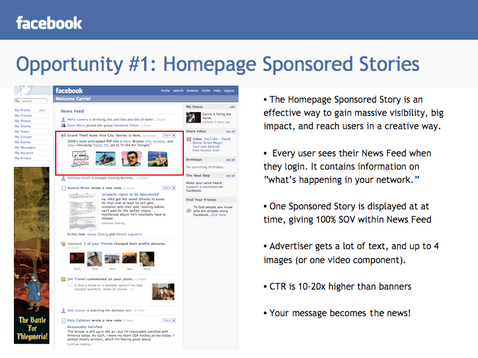
Traditionally, Facebook has been reluctant to fill up its social content feeds and streams with ads. However, they have rolled out Sponsored Stories for ad units. This new option will open up a viable new ad inventory that can include placements on the home page.

Facebook’s Platform for Marketers

Although Facebook is just past it’s 8 year mark since launch, it is still a rather new platform on which marketers can share their message, products or services.  Until recently, the method for spreading that message was the same as usual, create your message and share it with your most targeted audience. This seems to have left the medium and the message itself, out of sync. Expected results ensued. Most folks do not sign onto Facebook to be advertised to, or to look for places to purchase items of interests. Those who used conversion tracking were given a clear picture, the standard Facebook ads did not work. Shortly afterwards, social metrics were introduced in place of conversion tracking.

Many believe that if marketers can learn how to leverage the unique opportunity offered by Sponsored Stories, that they can thrive on Facebook.

Facebook’s Social Content Streams

While Facebook has traditionally be averse to filling their social content stream with ads, they recently began offering their Sponsored Stories ad units in the fully site wide ticker that includes real-time social activities and stories. The thoughts behind the benefits are that this will open up a valuable new ad inventory that includes placements on the users home page. So while they do remain as paid ads, the Sponsored Stories actually display your ad in a friends or your page users’ “Likes” which avoids the less invasive and annoying standard ads.

There may be the unintentional side effect that some viewers and users are not expecting advertisements to escape the confines of the lowly right sidebar, but in general, so far, the ads have proven to be quite effective for social advertising. Current ad units allow brands to purchase additional exposure, however, beginning in August, Facebook began blending the Sponsored Stories in with things like the game apps friends are using, or specific content they are following using other canvas apps.

How Do I Use Sponsored Ads to My Advantage?

There are several ways that marketers can take advantage of the ad units offered in Sponsored Stories. This includes several ad types where marketers or small business owners with Facebook pages can select from the type of ad that works best for their product or services.
Marketers will now be able to customize Facebook ads to their specific needs with only a few basic restrictions. The ad content must still complete with Facebook guidelines. Any images must be properly sized and formatted, and ad text must be 90 characters or fewer.

The marketer will get to target the perimeters that will determine the overall reach of the standard ad. With zero perimeters set that would mean that all of Facebook’s almost 1 billion users could see it. However, that would also be a phenomenal waste of money when highly detained perimeters can be set to target the exact demographics that are relevant to your product. The ad can be targeted so specifically that marketers can choose settings that will enable their ad to reach anywhere from 1 user to the over 850 million now on Facebook.

The 6 Types of Facebook Sponsored Stories

There are six different types of Sponsored Story ads to choose from.

Page Like Story

Page like ads are those where a user has “Liked” your page directly from the box on your website or from Facebook.

Page Post Like Story

This is where one of your fans has “Liked” one of your post in the past seven days.

App Used and Game Played Story

This means someone has played your game or used your app at least twice for a minimum of ten minutes in the past month.

App Share Story

This means that someone has shared a story from your app in the past seven days.

Check-In Story

A check-in story is where a user checked-in or claimed a deal in the last seven days at one of the Facebook claimed places.

Domain Story

A domain story means that a user shared a piece of content from your website using the Share button, shared a piece of your content using the “Like” button, or pasted a link to your site in their status window, in the last seven days.

Author:

@BasilPuglisi is the Executive Director and Publisher for Digital Brand Marketing Education (dbmei.com). Basil C. Puglisi is also the President of Puglisi Consulting Group, Inc. A Digital Brand Marketing Consultancy that manages professional and personal branding for Fortune 500 CEOs, Hedge Fund Managers and Small Business Owners.

Sources:

  • Sponsored Stories Ticker
  • Facebook announces Offers, New Sponsored Stories, & Mobile Ads
  • Clickable – Facebook Sponsored Stories Whitepaper
  • Sponsored Stories PDF Guide

Share this:

  • Share on LinkedIn (Opens in new window) LinkedIn
  • Share on Facebook (Opens in new window) Facebook
  • Share on Mastodon (Opens in new window) Mastodon
  • Share on Reddit (Opens in new window) Reddit
  • Share on X (Opens in new window) X
  • Share on Bluesky (Opens in new window) Bluesky
  • Share on Pinterest (Opens in new window) Pinterest
  • Email a link to a friend (Opens in new window) Email

Like this:

Like Loading…

Related

Filed Under: Digital Factics Blog, General, Social Media Tagged With: 1-800-Flowers, advertising, Class action, facebook, Facebook features, Marketing, Online Communities, social network, Sponsor (commercial)

Subscribe to Blog via Email

Enter your email address to subscribe

Join 9,585 other subscribers

Reader Interactions

Comments

  1. Richard Nelson says

    June 3, 2012 at 2:13 pm

    What an excellent post, thanks for the info. What are some tips you’d offer for Facebook ad services? I heard do not go with PPC there, but have never used FB ads before due to lack of remarkable suggestions.

    Loading...
    Reply
    • Basil C. Puglisi says

      June 4, 2012 at 11:12 am

      Richard stay tuned, we have a few articles about this in our roll, specifically a Facebook Ads for Proferssional Services, i.e. Lawyers and CPAs etc.

      My advice with Facebook Ads is to target the PPC to the smallest possible market if you goal is conversion, if your goal is brand awareness then keep that target wide for maximum impressions.

      Micro Targeting is the best asset that a Facebook has and the solution for a limited budget.

      Loading...
      Reply

Leave a ReplyCancel reply

Primary Sidebar

Subscribe via Email

Join 9,585 other subscribers
iDBasil C. Puglisi on ORCID

Buy the eBook on Amazon

This is an banner ad for the book Governing AI When Capability Exceeds Control
Buy the book Digital Factics on Amazon

Advanced Site Search

Responsible AI (#AIgenerated by Agents)

India’s Telecom Regulator Would Require a Designated Officer’s Approval Before Any AI System Is Used #AIg

TRAI’s draft guidelines on responsible AI in telecom would require a designated officer to approve every AI system before use and make operators accountable for vendor-built AI. They say less about who rules on outputs once a system is running. Comments are due November 27.

Only a Quarter of UK Workers Always Verify AI Answers. Who Decides Which Ones Count? #AIg

O’Reilly found that only 24% of UK employees always verify AI-generated answers, and 39% of those using them have acted on one that proved wrong. Perceptyx and RGP point to the missing piece: deciding which AI outputs need a named person’s ruling.

New AI Certificates for Doctors and Teachers Teach Checking. Do They Certify It? #AIg

Google launched an AI certificate for healthcare professionals that takes under five hours and carries up to 5.0 CME credits, and Scale and UMSL launched a 12-hour microcredential for teachers. Both teach evaluation of AI output. A European teacher framework asks for evidence of it, and employers can too.

OpenAI Built Four Layers to Watch Its Agents. Human Paging Mostly Keeps Business Hours #AIg

OpenAI’s October 29 post describes up to four automated layers that watch its agents, then discloses that human paging runs at any hour only for highest-priority alerts on frontier training runs, during business hours for most other traffic, and is currently off for internal Codex. For enterprise deployments, alerts go to the customer’s own webhook, and on our reading so does the decision.

House Democrats Ask AI Labs for Incident Reports Within 48 Hours of Discovery #AIg

Letters dated October 27 ask five frontier AI companies for a full accounting of misalignment incidents by November 11 and notice within 48 hours of discovery. None of the fourteen requested items asks who inside a company decides a flagged event is an incident, and that decision is what starts the clock.

A New Jersey Bill Takes Reasonable Care Off the Table for Chatbot Injuries #AIg

New Jersey’s A5607, reported out of committee on October 19, would make a chatbot a product and hold its provider liable for any injury to a user from its use, even after all reasonable care. The monthly harm assessment it requires still needs a named person to decide what the numbers mean.

Europe Proposes Free Access to the Standards Behind AI Act Compliance #AIg

The European Commission proposed on October 6 to make standards referenced in EU law free to read, speed up how they are requested and assessed, and write its own common specifications when standards bodies run late. With EN 18286 now the first AI Act standard, the question is what a faster standard can certify.

More Posts from this Category

#SMAC #SocialMediaWeek

Basil Social Media Week

Legacy Print:

Digital Factics: Twitter

© 2009–2026 Basil C. Puglisi, Creator of Factics™ and the HAIA Ecosystem

%d