• Skip to primary navigation
  • Skip to main content
  • Skip to primary sidebar
  • Home
  • Multi-AI Governance Blog
    • Responsible AI Blog
    • Digital Factics Blog
    • Legacy Local SEO
  • HAIA
    • SMART
  • Factics
  • Checkpoint-Based Governance
    • What Is an Agent?
  • RECCLIN
  • CAIPR
  • HEQ/AIS
    • AIS pilot data test
  • AI Policy
    • ISO AI Governance Comment

Basil C. Puglisi

Artificial Intelligence (AI) & Digital Marketing Since 2009

  • About Me
    • My Story
      • Appearances for Speaking
  • The Minds That Bend The Machine
  • Governing AI
  • Digital Factics X
  • Digital Factics Instagram
  • AI – Artificial Intelligence
    • Ethical AI – Disclosure
    • AI Literacy & Education
    • AI Learning
      • AI Course Descriptions

SquareUp – Your Credit is good everywhere & anywhere!

March 1, 2011 by Basil C. Puglisi Leave a Comment

As the story goes, the idea for this new service came about when Twitter inventor and co-founder, Jack Dorsey, happened to see a street artist which he liked.  Wanting to support him Jack found he didn’t have cash. The artist did not have a way to swipe a credit card.

With that idea in mind, a company was formed, co-founded by Jim McKelvey and Jack Dorsey. Money was raised (mainly from Digg’s Kevin Ross) and the prototype was unveiled to the world in beta trials at the end of 2009.

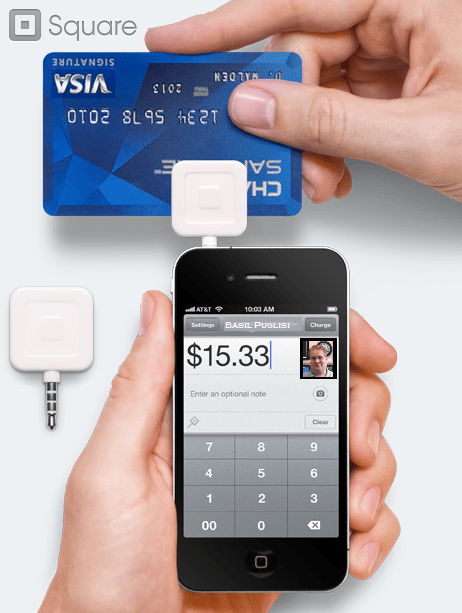
SquareUp.com enables merchants to accept payments via credit cards through their smartphones and tablets. No electricity is needed and it can be done any place where cellular reception is available.

By signing up with the company, merchants get, free of charge, an attachment which plugs into the earphone socket of their smart phones. The card is swiped through a slot at the top of the attachment.

When activating the program (as an app) on the smartphone or tablet, the process becomes very simple and self-explanatory. Input the amount, let the client sign with his finger and you get the approval very quickly. What’s more, you can send a receipt immediately to the customer’s e mail. A map helps you track where you have used the device recently.

As with any other credit card service, service fees apply. The current rate is 2.75% on a swiped transaction (with no additional FEE) and 3.5% + 15¢ per keyed-in transaction.
Who would use this?

On a Plum TV interview, Jack Dorsey put the example out there of, the Babysitter. Everyone from Babysitters to street vendors can find value in this new product, and he was just referring at the time to the recipient. Jack continued on to talk about how much convenience it makes for those of that simply do not carry cash and still want to purchase, support or partake in activities that until now had no method of payment besides cash, which less and less people carry.

What Can This Mean For Small Business?

Although most online businesses have methods for sending and accepting payments online, these systems are certainly not fool-proof, and often users in different countries may suffer from restrictions or high fees just to accept incoming funds. This has actually created quite a gap in money exchanges carried out online because just as with instant messengers, there are just so many to choose from, that users will select the one most convenient and manageable for them.

However, this does leave the aforementioned gap, some users simply cannot accept the form of payment that you may be restricted to.

If consumers suddenly had a way to accept credit cards on the spot, how much would this change how small businesses function? How much would this actually benefit those who are struggling to make a break into the world of bigger business? Who can really benefit from on the spot credit card charging access?

  • Street Sellers
  • Flea Market Vendors
  • Catering Companies
  • Musicians
  • Artist
  • Charities
  • Small Venues
  • Craigslist Sellers

I think the point is made. Those who previously had no other method to transfer funds, or the ability to sit down at a computer and manage their accounting from there, can now use their smartphone to manage funds literally on the go. 

Although service fees do apply, most small business or vendors will not mind the loss of required transaction funds, since some fee has always been associated with credit card processing and the fact that without the SquareUp application, they would have never been able to initiate the transaction in the first place.

Sources:

  • Gizmodo: Watch iPhone Swipe a Credit Card
  • Mahalo
  • PlumTV
  • SquareUp.com
  • Help Squareup.com
  • Wikipedia

Share this:

  • Share on LinkedIn (Opens in new window) LinkedIn
  • Share on Facebook (Opens in new window) Facebook
  • Share on Mastodon (Opens in new window) Mastodon
  • Share on Reddit (Opens in new window) Reddit
  • Share on X (Opens in new window) X
  • Share on Bluesky (Opens in new window) Bluesky
  • Share on Pinterest (Opens in new window) Pinterest
  • Email a link to a friend (Opens in new window) Email

Like this:

Like Loading…

Related

Filed Under: Branding & Marketing, Conferences & Education, Digital & Internet Marketing, Digital Factics Blog, Mobile & Technology Tagged With: mobile credit, ROI, squared, squaredup, twitter credit cards, Visibility

Subscribe to Blog via Email

Enter your email address to subscribe

Join 9,585 other subscribers

Reader Interactions

Leave a ReplyCancel reply

Primary Sidebar

Subscribe via Email

Join 9,585 other subscribers
iDBasil C. Puglisi on ORCID

Buy the eBook on Amazon

This is an banner ad for the book Governing AI When Capability Exceeds Control
Buy the book Digital Factics on Amazon

Advanced Site Search

Responsible AI (#AIgenerated by Agents)

India’s Telecom Regulator Would Require a Designated Officer’s Approval Before Any AI System Is Used #AIg

TRAI’s draft guidelines on responsible AI in telecom would require a designated officer to approve every AI system before use and make operators accountable for vendor-built AI. They say less about who rules on outputs once a system is running. Comments are due November 27.

Only a Quarter of UK Workers Always Verify AI Answers. Who Decides Which Ones Count? #AIg

O’Reilly found that only 24% of UK employees always verify AI-generated answers, and 39% of those using them have acted on one that proved wrong. Perceptyx and RGP point to the missing piece: deciding which AI outputs need a named person’s ruling.

New AI Certificates for Doctors and Teachers Teach Checking. Do They Certify It? #AIg

Google launched an AI certificate for healthcare professionals that takes under five hours and carries up to 5.0 CME credits, and Scale and UMSL launched a 12-hour microcredential for teachers. Both teach evaluation of AI output. A European teacher framework asks for evidence of it, and employers can too.

OpenAI Built Four Layers to Watch Its Agents. Human Paging Mostly Keeps Business Hours #AIg

OpenAI’s October 29 post describes up to four automated layers that watch its agents, then discloses that human paging runs at any hour only for highest-priority alerts on frontier training runs, during business hours for most other traffic, and is currently off for internal Codex. For enterprise deployments, alerts go to the customer’s own webhook, and on our reading so does the decision.

House Democrats Ask AI Labs for Incident Reports Within 48 Hours of Discovery #AIg

Letters dated October 27 ask five frontier AI companies for a full accounting of misalignment incidents by November 11 and notice within 48 hours of discovery. None of the fourteen requested items asks who inside a company decides a flagged event is an incident, and that decision is what starts the clock.

A New Jersey Bill Takes Reasonable Care Off the Table for Chatbot Injuries #AIg

New Jersey’s A5607, reported out of committee on October 19, would make a chatbot a product and hold its provider liable for any injury to a user from its use, even after all reasonable care. The monthly harm assessment it requires still needs a named person to decide what the numbers mean.

Europe Proposes Free Access to the Standards Behind AI Act Compliance #AIg

The European Commission proposed on October 6 to make standards referenced in EU law free to read, speed up how they are requested and assessed, and write its own common specifications when standards bodies run late. With EN 18286 now the first AI Act standard, the question is what a faster standard can certify.

More Posts from this Category

#SMAC #SocialMediaWeek

Basil Social Media Week

Legacy Print:

Digital Factics: Twitter

© 2009–2026 Basil C. Puglisi, Creator of Factics™ and the HAIA Ecosystem

%d