What has not been said and written about Facebook? Articles, numerous books and a movie -“Social Network”, which is nominated for this year’s Oscar awards. Mark Zuckerberg, the name and the face of Facebook was the subject of exposes and studies; how did a 20 some year old managed to create a company from his dorm room that is now estimated to be worth 50 billion dollars?

Facebook is a social network website, launched almost exactly 7 years ago (Feb. 4, 2004). This free access site is privately owned and operated by Facebook Inc. Each registered user gets a profile page on which s/he can write, post links and share experiences. Users can upload pictures, links to website they found interesting and stories they found fascinating. They can share it all with members of their circle of friends.
Users can join networks organized by businesses, workplaces, schools and connect and interact with other people. They can find friends from the past and make new connections.
Facebook has distinguished itself from its rivals partly because it offers a Spartan design ethos and limits how users can change the appearance of their profile page. This cuts down on visual clutter and threats like spam which plagued social sites. Many analysts see Facebook as the default platform of a new age of information organized around personal relationships.
Throughout the years, this social network has transformed from a college only social club to the most popular website in the world. With over 500 million users it overtook Google as the most visited website, and is a broadly popular online destination, used by teenagers and adults of all ages. In country after country Facebook is cementing itself as the leader, often displacing other social networks, much in the same way it overtook MySpace in the US.
The headquarters moved to Palo Alto from Harvard University in June 2004. In September of that year the Group Application was added and the Wall made its debut. By the end of this first year, TheFacebook, as it was called then, had 1 million users. The photo application was added in 2005 and at the end of that year Facebook had 5.5 million users.
In 2006 Facebook mobile debuted, the Facebook Platform was launched, Note Application and News Feed. By the end of the year it has 12 million users.
2007 saw the launch of Ads, apps and Platform. Facebook invited third party software makers to create programs for the company and to make money on advertising alongside them. The announcement drew many programmers and hundreds of new features or social application were creates. From games to music and photo sharing tools, which turbo charged the site. But users were complaining about the privacy settings that were visible to all.
In 2008 Facebook adds privacy controls to ‘friends’ lists, launches Chat and Facebook Connect. In
2009 it introduced the “Like” feature and acquired FriendFeed. By the end of the year Facebook had 350 million users.
2010 – Facebook Places was launched and Messages arrived in an attempt to expand from a social network into a full-fledged communications system. E mails, text messaging and chat through a single point is what Facebook was after. Time magazine names Mark Zuckerberg “Person of the Year” and the movie debuted.
At the beginning of 2011 – Facebook is valued at $50 billion, when it raises 500 million from Goldman-Sacks and a Russian investor.
Facebook policies, more than those of any other company, are the ones to define standards for privacy in the internet age.
Many companies tried to buy Facebook and were met with a tough refusal. In 2006 Yahoo tried to buy the company for $1 billion. The company earned $335 million on 1.2 billion in revenue during the first nine months of 2010, but that is only a rumor, Zuckerberg keeps those numbers close to the vest.
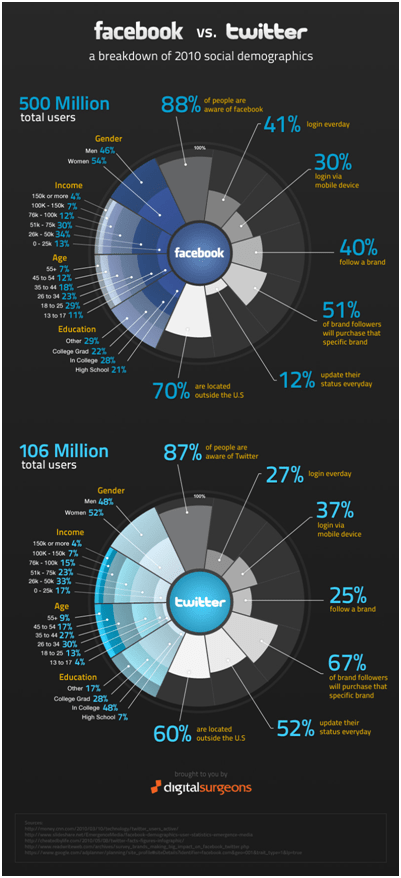
Facebook built its lead not only through savvy design but also by rapid deployment of features that increased the site’s appeal. And indeed as statistics shows, 88% of people around the world are aware of Facebook.
As for active users, males make 46% of Facebook users, and it is spread almost evenly between age groups; 11% of the users are 13-17 olds, 29% are 18-25, 23% between the ages of 26-34, 18% 35-44 and 12% between 45 and 54. It is also spread evenly between levels of education.
This goes to show that the success of Facebook lies in the fact that it reaches all ages and all nationalities. Their constant innovation and additions in the form of apps and programs is what keeps the company ahead of the game.
Well established companies have been using Facebook in different and interesting ways; As a promotion tool; a campaign by Gap for a giveaway of 10,000 pair of jeans was announced only on Facebook. The pants were gone as soon as the stores opened. Calvin Klein regularly announces sales and posts coupons. As of Nov. 15 they have 332,521 ‘friends’.
As for brand engagement – Taco Bell is responsive to fan comments and has generated strong positive feedback when it posts promotions. Zara, the clothing chain, has 1,581,000 fans; Target has 588,300 fans and engages its audience with votes about charitable donations. MTV has 1,146,737 fans and engages its audience with a fast moving page and consistent fan engagement. So does Pizza Hut with its over 1 million fans.
With so many active users Facebook has established a new way of communication, a new way of maintaining relationships and a new way in advertising. The company still turns down offers to buy them and plan, as the speculation goes, to go public in 2012.

Sources:
Leave a Reply