We were all asking ourselves what will be Apple’s next big thing. What new device did Steve Jobs nurture before his untimely demise?
Is it going to be Apple TV which Jobs was talking about in the past few years? A new sleek and shiny gadget we couldn’t do without?
About 10 days ago, and without the usual fanfare reserved for a new gadget, Apple revealed their new big project.
Changing education by making text books and knowledge easily accessible to all.
At the event, which was held at the Guggenheim Museum in NYC, Apple executives said: “We try to bring the same energy and passion we’ve put into every product we make into our education business as well.” They start by reinventing the k-12 school textbooks.
Armed with the fact that there already are over 1 ½ million iPads used for education and over 200,000 learning apps, they are expending their reach by introducing 3 new components:
iBooks 2
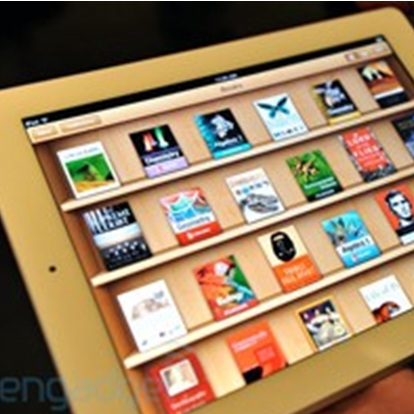 This is a reinvention of the iBooks store and is geared toward textbooks. And what textbooks do they offer? One example is the excellent E .O Wilson’s book “Life on Earth”.
This kind of Interactive book is similar to the interactive wonder the guys from Push Pop Press did with Al Gore’s book “Our Choice”. The book was presented in a TED conference in Sept. 2009 and in many minds showed the possibilities of future education. Pop Push Press was consequently bought by Facebook in August 2011. I believed at the time Facebook is aiming to change the textbook, but Apple seems to beat them to it.
The new interactive books, with text, images and videos offer everything in such an elegant and seamless way. You tap on the picture, it becomes full screen, you pinch it small and it goes back to where it was before. Slides of microscopic looks and vast vistas are a simple click away.
To get the feel of this new book you can download “Life on Earth” free of charge. It might take some time because the file is heavy but it is well worth it.
Apple hopes that many more educators will put time (and money) into creating new books which will be presented at the iBooks 2 stores and will be accessible without charge.
The other kind of interactive books are the traditional textbooks, used by students all over the United State grades k-12. You can see a sample of the book on Chemistry from McGraw Hill. It not only looks more appealing than the traditional book, with more graphics and charts, it is interactive because you can do things with the book. You can tap and drag to highlight text you think is important, you can type note relevant to the page and you can collect all of them in one place, replacing notes and cue cards.
Those textbooks will cost no more than $14.99. Major publishers such as Houghton Miffilin Harcourt, McGraw Hill and Pearson are already working with Apple to produce more books.
iBook Author
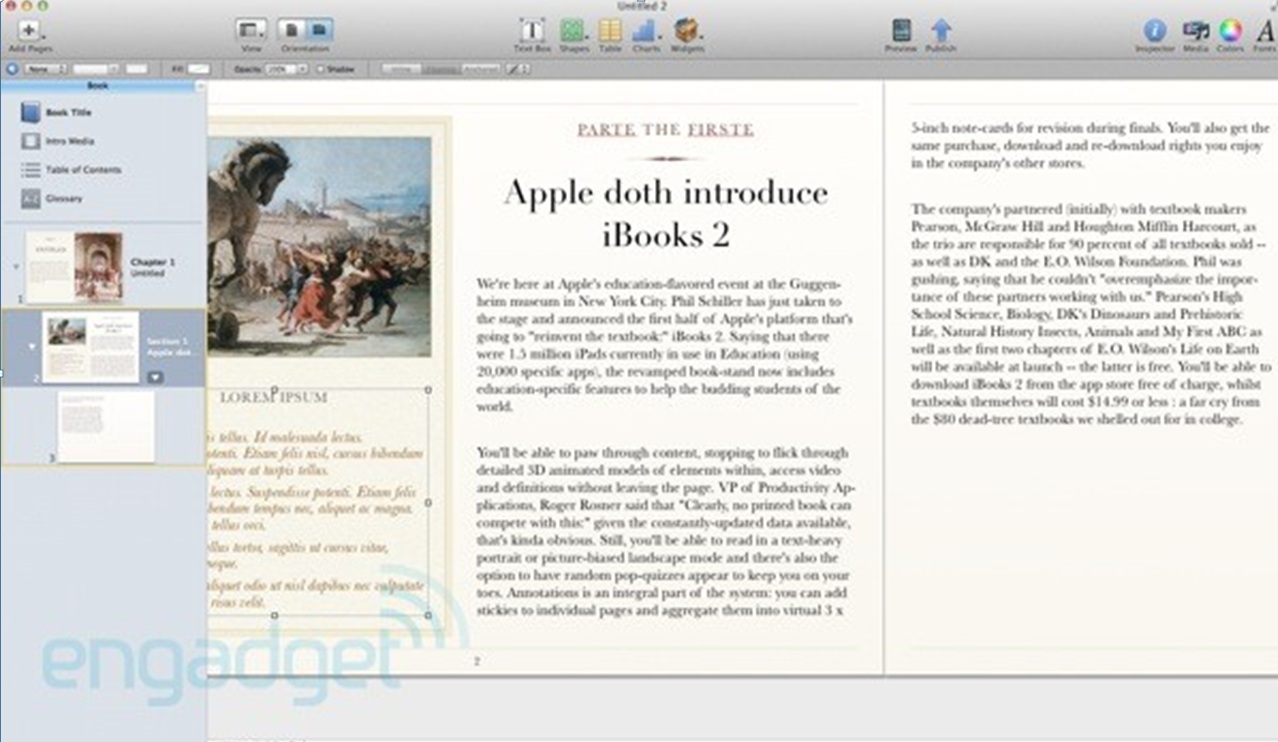
To facilitate the creation on new books, Apple released a free OS X program. Those who’ve tried it say it is every bit as promised. It makes life very simple by dragging and dropping media in the places you want it to be. (http://www.engadget.com/2012/01/19/apples-ibooks-author-hands-on/)
Teachers can create their own books and share them with their students on iPads. They can expend to areas beyond the curriculum and design a lively course that can be easily updated as new research becomes public. They can post assignments and class schedules.
Why would a teacher do that instead of telling the students to find it by themselves? There is too much information on the web, apple executives say. Sorting it out, knowing what is important and putting it all in one place is the future of education. Pending Apple’s approval, the books will be published for free, in the iBooks store.
There’s another model of selling the books, in partnership with Apple (70/30). The books have a price limit of $14.99.
iTunes U
iTunes U has been around for almost 4 years, with very little attention outside the academic world. Regardless of this fact, more than 700 million downloads have already been made. Now the service is getting its own app.
iTunes U has a collection of thousands of courses from different universities. Some look like a spiral notebook and when you open them you can find the course description, the syllabus and the teacher’s bio. You can find out ahead of time what you are getting yourself into. The integration with iBooks is complete. If it says in the course you need to read an article from a certain book, no need to look it up in the store. A click will link you directly to the correct book and the right page. One click will get you back to the 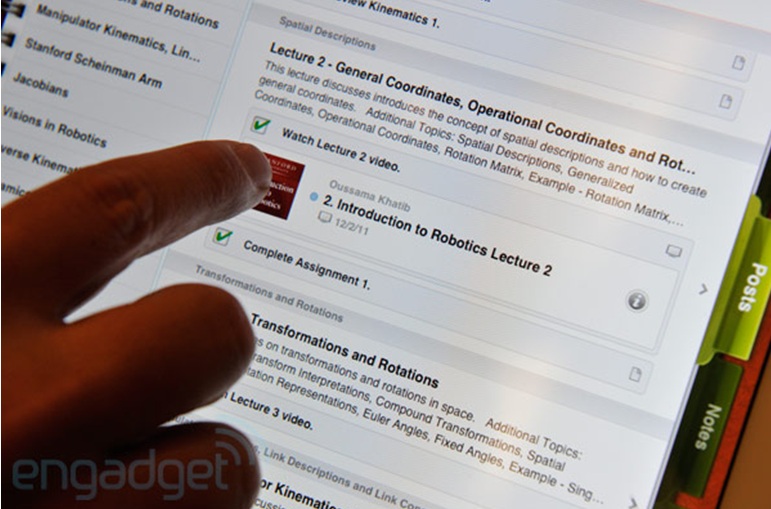 course and your homework. Some of the courses have live lectures as well. Teachers post assignments, homework and can leave notes. The Open University has some wonderful books on various subjects, for courses to be taken online.
The iPad can be now the only learning tool you will need. You can highlight sections, you can type notes, and you can have it all in one easy place for review.
No more excuses. Now you can learn anything, anywhere, anytime.
Author:
@BasilPuglisi is the Executive Director and Publisher for Digital Brand Marketing Education (dbmei.com). Basil C. Puglisi is also the President of Puglisi Consulting Group, Inc. A Digital Brand Marketing Consultancy that manages professional and personal branding for Fortune 500 CEOs, Hedge Fund Managers and Small Business Owners.
Sources:
- http://www.engadget.com/2012/01/19/apples-education-announcement-what-you-need-to-know/
- http://digitalbrandmarketing.com/2011/08/11/
- http://www.appleinsider.com/articles/12/01/18/apples_education_event_will_focus_on_textbooks_for_k_12_students___report.html
- http://www.wired.com/geekdad/2012/01/apple-edtech/
- http://www.huffingtonpost.com/2012/01/19/apple-ibooks-2-author-itunes-u_n_1215887.html
- http://news.cnet.com/8301-13579_3-57360688-37/apple-unveils-ibooks-2-for-digital-textbooks-self-pub-app-live-blog/
Great post Basil and part of your passion for education. Does this mean that all the dbme blog authors are going to get iPads to use?