Twitter is becoming part of our lives whether we are active users or not. Twitter has found itself as the exclusive information tool, scooping Osama Bin Laden Death and now the latest in business and brands. There are so many uses to this short burst of 140 characters, and new ones are being discovered every day. We cannot ignore its existence because it touches many aspects of our lives.
One aspect of today’s world brought about by Twitter is that secrets are something much harder to keep these days. Tweets by innocent bystanders about a clandestine operation can foil a mission. Tweets of conduct unbecoming elected official find themselves, with one mistaken click of a button, broadcasted to the whole world. A claim of hacking did not hold water in Anthony Weiner’s case and another claim of hacking, this time on FoxNewsPolitics, are being investigated by the security services. On July 4, 2011, six tweets appeared from that source announcing the premature death of President Obama, who was presumably assassinated in a Diner. Jokes aside (“The rumors of my demise are greatly exaggerated” Mark Twain said so succinctly), it poses a great risk to the validity of news sources.
Theoretically, to prevent foul play, Twitter has a service called Verified Tweets, which has been in existence since 2009. Twitter is using it to prevent confusion by verifying the person behind the account. It has been done with important and famous people and with Twitter’s advertisers and partners. The verification process was open to the public for a short time in beta testing, but it is now closed. “In the meantime, we’re still verifying some trusted sources, such as our advertisers and partners. If you’re one of our partners or advertisers, please follow up with your account manager for details.” It says on their blog. Obviously Fox news is a verified tweeter, so what about trusting the news?
And there’s the aspect of commerce using Twitter. “Promoted tweets” are ones that are paid for by the advertiser. Twitter handles 50 million tweets a day and Promoted Tweets are twitter advertising platform. In Apr. 2010 Twitter.com rolled out a system where ads can appear at the top of some Twitter.com search results pages. They are labeled as “Promoted “and retain all the other functions of a tweet. Twitter.com has expand it to Promoted Accounts, in which people and brands are buying their way onto your “who to follow” list.
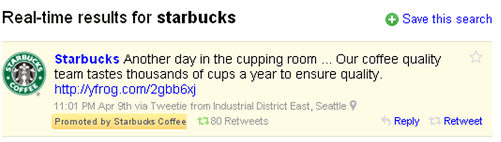
It seems that while some larger companies are still trying to figure out social media, there are those who already have. Here are some, that experts agree, who excel in using Twitter.
- Starbucks – 1.5 million followers and is the most socially engaged. It ranks on top of fast customer interaction. It’s about the relationships with the customer, they say, not marketing. Which is a good marketing slogan in itself. Starbucks hosts polls, contests and shares photos and videos.

- Southwest Airlines – Tries to replicating the casual atmosphere on their flights into their tweets. The only company that knows how to make someone LUV the company (LUV is the Love Field in Dallas, the headquarters of the company).
- New York Times – This news organization broadcasts the news in 140 characters. It has subchannels for specific interests and reaches 2.4 million readers.
- JetBlue – After their nightmare in 2007 (“a day on the tarmac”) JetBlue is keeping constant communication with its followers (1.6 million). It uses tweets to broadcast special deals to their 50,000 most loyal customers. They have 14 people tweeting for the account; assisting, apologizing and solving problems.
- Zappos – The online retailer keeps in touch with its customers, encouraging anybody, from the CEO to the newest employee to join the party.
- Cisco Systems – The company shows how well business to business can do on twitter. They ask and answer questions.
- Bergdorf Goodman – They tweet about New York, fashion and style, engaging their customers in conversations and showing them things the followers would be interested in.
- Whole Foods Market – They use Twitter to go deep in their customers’ needs and test new concepts. They extend the discussion to the philosophy behind their business.
- Dell – Getting their inventory and older equipment out the door fast, Dell is using Twitter. It is a fast grapevine that broadcasts the news. The sales are $3 million a year using this method.
- Home depot – It goes beyond product and store questions to help in many home improvement projects.
A great example of how I have seen twitter impact communication and win business can be seen in these two previous articles:
- A look at how important Twitter is to customer service: Palms Casino, Las Vegas
- What Could be better than a weekend in Vegas? A Free Weekend in Vegas!
[youtube=http://www.youtube.com/watch?v=CzyD-cTRoAA]

Sources:
- Ad Age: Twitter a business model promoted Tweets
- CNBC: Top Ten Companies on Twitter
- Media Shark LLC: 9 Lessons from Successful Brands on Twitter
- Mashable: Best Twitter Brands
- Twitter: About Verified Accounts
- Twitter: What Arte Promoted Tweets
- Wired: Promoted Tweets could appear in twitter timeline within two months
Leave a Reply